Weed is the hardest common bottom to anchor in, and the reason is that it produces a set that feels entirely convincing and is not.
What actually happens
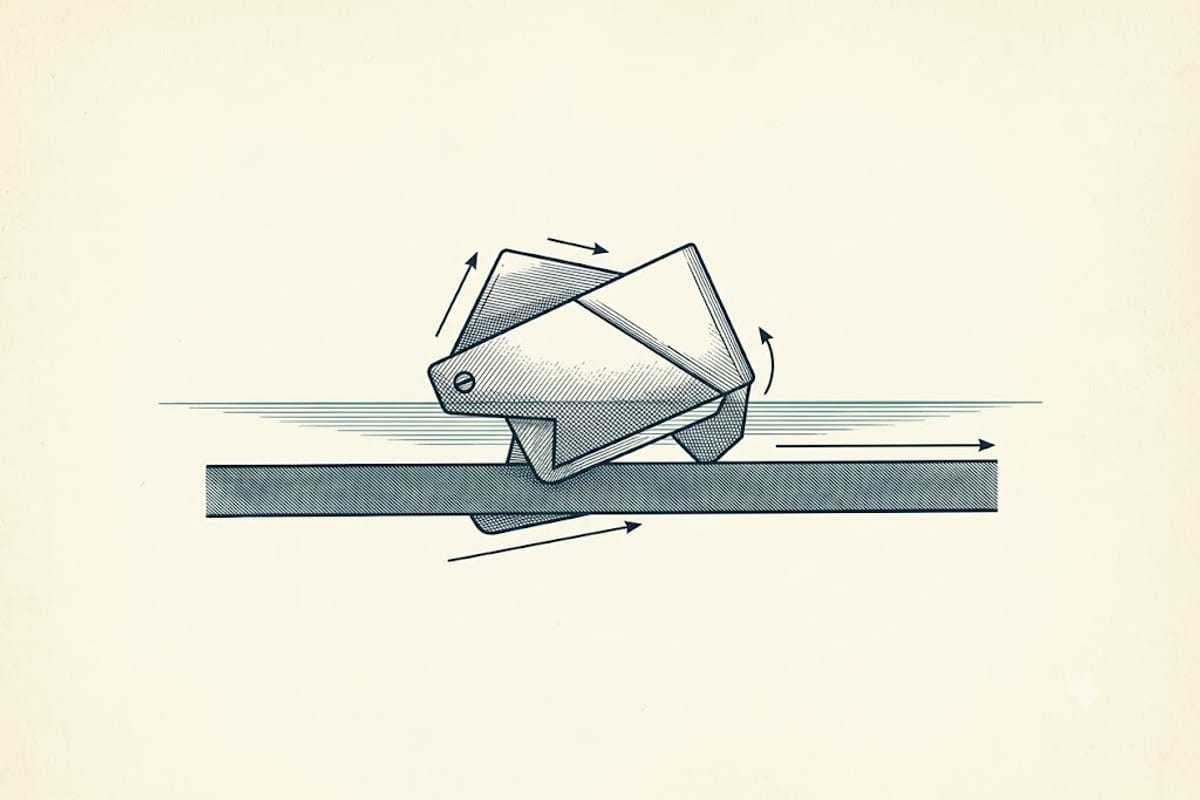
Grass and weed form a dense mat above the seabed. An anchor lowered onto it comes to rest on the mat, and the flukes have to cut through vegetation before they reach anything that will hold.
The mat itself offers real resistance. Pull back gently and the anchor holds — against roots and tangled growth, not against the bottom. The boat lies quietly, the snubber takes up, and everything looks right.
Then the wind shifts or increases, the load rises, the mat tears, and the anchor moves. Weed dragging is characteristically sudden rather than gradual.
Which anchors cope
Concave modern designs — Rocna, Mantus, Spade, Vulcan — have the best record in weed. The concave shape and the weight concentration at the tip help the anchor cut down rather than skate.
Plough types manage moderately. They have a defined point and enough weight forward to penetrate a thinner mat.
Fluke anchors are the worst. The flukes need to open and dig, and a mat holds them closed. A Danforth in thick grass frequently comes up with a ball of vegetation between the flukes, which is the clearest possible evidence that it never set.
Technique that improves the odds
Lower slowly and let it sit. Dropping the whole rode at once piles chain on top of the anchor and prevents it from orienting. Lower to the bottom, then let the boat drift back while paying out.
More scope, not more throttle. A shallow pull angle is what allows the tip to work down through the mat. Backing hard on short scope skids the anchor across the top.
Set in stages. Take up gently, hold, wait, then increase. Weed rewards patience in a way that sand does not.
If it does not set in two attempts, move. A third attempt in the same patch will usually fail the same way. Weed is often patchy, and a spot fifty metres away can be clear sand.
Confirming a set in weed
The usual checks are less reliable here, so use more than one.
Transits. Line up two fixed objects ashore and watch. This is the most sensitive drag detection available and it costs nothing.
Feel the rode. A set anchor transmits a steady tension. One dragging through weed produces an intermittent, jerky feel that can be detected by hand on the chain.
Anchor alarm, set with a realistic radius, as a backstop rather than a primary check.
Swim on it where conditions allow. In clear water this is definitive, and it is the only method that shows you whether the anchor is buried or lying on top.
After it comes up
Look at the anchor. Vegetation wrapped around the flukes or packed between them means it did not penetrate. A clean anchor with mud or sand on it means it did.
That inspection on retrieval is the honest record of whether last night was safe or lucky, and it is worth making a habit of it.
The wider lesson
Weed is where a second anchor earns its place aboard. A boat that cruises grassy anchorages regularly benefits from carrying a modern concave anchor as the primary regardless of what came with the boat, because the failure mode in weed is sudden and happens at night.
Reading the chart and the water
Charts often show the bottom type, and weed is worth avoiding at the planning stage rather than discovering at the pointy end of the evening. Where the chart is silent, clear water shows it plainly from the bow, and a dark patch is usually grass while a light patch is usually sand.
Local knowledge is better than either. In anchorages known for weed, the boats that have been there before are frequently all clustered in one area, and that area is normally the sand.
Protected seagrass
Several jurisdictions protect seagrass beds and restrict or prohibit anchoring in them, with real penalties. Beyond the legal question, an anchor dragged through a bed does long-lasting damage to habitat that takes years to recover.
Where mooring buoys are provided in a protected anchorage, they exist for this reason and using them is both easier and better. Where they are not, choosing a sand patch is the responsible choice as well as the one that holds.