Scope & Holding
Scope is rode length divided by rise — and the rise is not the charted depth.
It is depth, plus the tidal range you will see before morning, plus the height of your bow roller above the water. Leave out the last term and a small boat in shallow water can overstate its scope by a fifth.
The anchor holds because of the angle the rode makes at the seabed. That angle starts where the rode leaves the boat, not where it enters the water.
Add the tide before you set, not after
A four-foot tidal range means a 7:1 scope at low water becomes something considerably less at high. Anchors drag on a rising tide, in the dark, when the boat you carefully anchored clear of is suddenly much closer than it was.
The standard scopes
5:1 is a minimum for fair weather with someone on watch. 7:1 is the overnight standard. 10:1 is for heavy weather. All-chain rode can hold at somewhat less because the chain's own weight keeps the pull horizontal; rope needs more, because it floats and lifts the shank.
The number nobody calculates: swing radius
More scope holds better and swings wider. In a crowded anchorage the limit is usually not holding power — it is whether the circle you will swing through is clear of other boats, moorings and shoal water.
That radius is not the rode length. It is the horizontal leg of the triangle, and it is worth knowing before you settle in next to someone.
A snubber is not optional on all chain
Chain has no stretch. Every wave shock loads the windlass and the bow fitting directly, and both are designed for static loads. A nylon snubber absorbs that, and it also quiets the boat enough to sleep in.
5 articles
5:1 scope in 35 ft of water with 4 ft of tide
| Rode length | 210ft |
|---|---|
| Total rise35 depth + 4 tide + 3 bow — measured from the bow roller, not the waterline | 42ft |
| Swing radiusthe circle you need clear of other boats and shoal | 206ft |
| Swing diameterif the wind boxes the compass | 412ft |
| Nominal scope | 5:1 |
| Effective scopethe usual small-boat setup | 5:1 |
| Rode type | rope with chain leader |
| At the 7:1 overnight standardmore than you are paying out now | 294ft |
Notes
- Measure the rise from the bow roller, not the waterline. The anchor is held by the ANGLE of the rode at the seabed, and that angle starts where the rode leaves the boat. On a boat with 3 ft of bow height in 35 ft of water, leaving it out overstates your scope by 7%.
- Add the tide before you set, not after. 4 ft of range means a 5:1 scope at low water becomes 5:1 at high — anchors drag on the flood, in the dark, when the boat you anchored clear of is suddenly close.
- 5:1 is a fair-weather, someone-on-watch scope. Overnight practice is 7:1, which here would be 294 ft of rode. Short scope is the most common reason anchors drag.
- Rope pulls upward on the anchor shank as it tensions, which is why it needs more scope than chain. A chain leader of at least a boat length keeps the pull at the anchor horizontal and takes the chafe on the bottom.
- Set it properly once it is down. Back down at low revs until the boat stops moving with the rode taut, then take a transit on shore and watch it for a few minutes. An anchor that has not been set is just a heavy object lying on the bottom.
Scope and rode length
240 calculations · browse all
- 3:1 scope in 6 ft of water with 0 ft of tide
- 5:1 scope in 6 ft of water with 0 ft of tide
- 10:1 scope in 6 ft of water with 0 ft of tide
- 5:1 scope in 8 ft of water with 0 ft of tide
- 7:1 scope in 8 ft of water with 0 ft of tide
- 3:1 scope in 10 ft of water with 0 ft of tide
- 7:1 scope in 10 ft of water with 0 ft of tide
- 10:1 scope in 10 ft of water with 0 ft of tide
- 5:1 scope in 12 ft of water with 0 ft of tide
- 10:1 scope in 12 ft of water with 0 ft of tide
- 3:1 scope in 15 ft of water with 0 ft of tide
- 7:1 scope in 15 ft of water with 0 ft of tide
- 3:1 scope in 18 ft of water with 0 ft of tide
- 5:1 scope in 18 ft of water with 0 ft of tide
- 10:1 scope in 18 ft of water with 0 ft of tide
- 5:1 scope in 20 ft of water with 0 ft of tide
- 7:1 scope in 20 ft of water with 0 ft of tide
- 3:1 scope in 25 ft of water with 0 ft of tide
- 7:1 scope in 25 ft of water with 0 ft of tide
- 10:1 scope in 25 ft of water with 0 ft of tide
- 5:1 scope in 30 ft of water with 0 ft of tide
- 10:1 scope in 30 ft of water with 0 ft of tide
- 3:1 scope in 35 ft of water with 0 ft of tide
- 7:1 scope in 35 ft of water with 0 ft of tide
- 3:1 scope in 40 ft of water with 0 ft of tide
- 5:1 scope in 40 ft of water with 0 ft of tide
- 10:1 scope in 40 ft of water with 0 ft of tide
- 5:1 scope in 45 ft of water with 0 ft of tide
- 7:1 scope in 45 ft of water with 0 ft of tide
- 3:1 scope in 50 ft of water with 0 ft of tide
- 7:1 scope in 50 ft of water with 0 ft of tide
- 10:1 scope in 50 ft of water with 0 ft of tide
- 5:1 scope in 60 ft of water with 0 ft of tide
- 10:1 scope in 60 ft of water with 0 ft of tide
- 3:1 scope in 70 ft of water with 0 ft of tide
- 7:1 scope in 70 ft of water with 0 ft of tide
- 3:1 scope in 80 ft of water with 0 ft of tide
- 5:1 scope in 80 ft of water with 0 ft of tide
- 10:1 scope in 80 ft of water with 0 ft of tide
- 5:1 scope in 90 ft of water with 0 ft of tide
- 7:1 scope in 90 ft of water with 0 ft of tide
- 3:1 scope in 100 ft of water with 0 ft of tide
- 7:1 scope in 100 ft of water with 0 ft of tide
- 10:1 scope in 100 ft of water with 0 ft of tide
- 5:1 scope in 5 ft of water with 0 ft of tide
- 10:1 scope in 5 ft of water with 0 ft of tide
- 3:1 scope in 7 ft of water with 0 ft of tide
- 7:1 scope in 7 ft of water with 0 ft of tide
 Scope in a Tidal Anchorage — Calculate for High Water, Not Now
The boat is anchored correctly at eight in the evening and under-scoped at two in the morning, and nothing changed except the water.
 Anchor Alarms — Set the Radius From the Anchor, Not the Boat
An alarm centred on the boat rather than the anchor gives you a circle offset by the whole length of the rode, and the gap is on the side you are drifting toward.
 Two Anchors: When a Second One Helps, and the Three Ways to Set It
A second anchor is the answer to a specific problem, not a general upgrade. Set for the wrong problem, it makes things worse than one anchor would have been.
 Your Anchor Is Dragging: How to Know, and What to Do in What Order
Boats at anchor move constantly, so the hard part is telling normal movement from a dragging anchor. Two checks separate them within a minute.
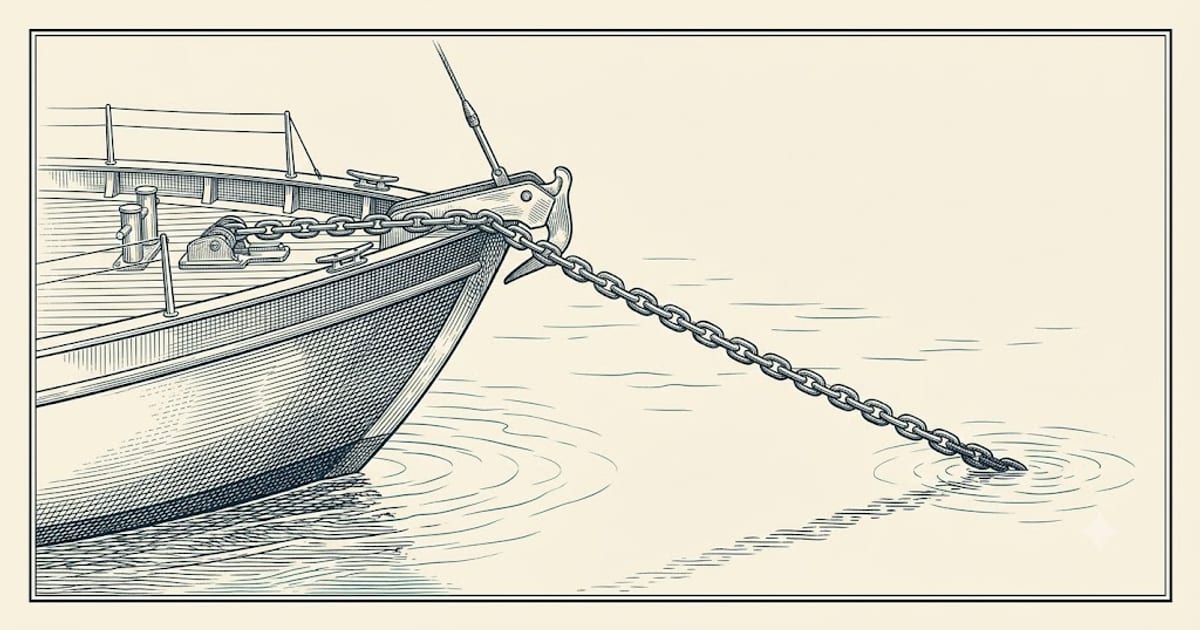 Anchor Scope: Why 7:1, When 5:1 Is Enough, and Where Chain Stops Helping
Scope is not about length. It is about the angle the rode pulls at the anchor, and every rule of thumb is a shortcut to that one number.