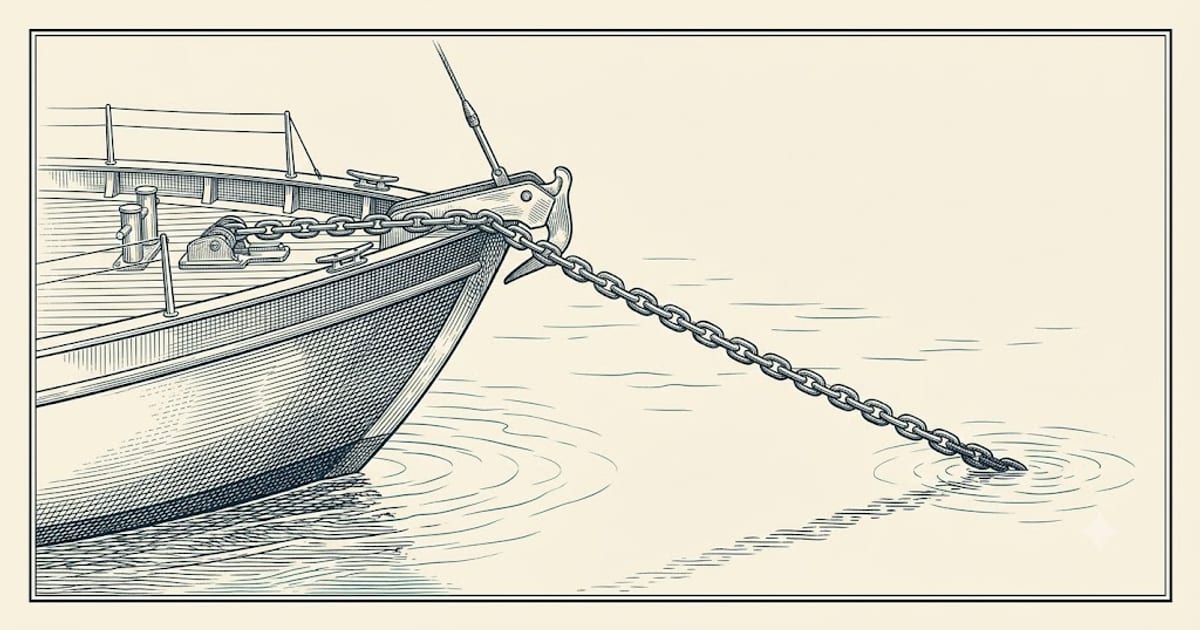
Scope is the ratio of rode paid out to the vertical distance it spans:
scope = rode length ÷ (depth + tidal rise to come + bow height)
That denominator catches people. It is not depth — it is depth plus the tide still to arrive plus the height from waterline to your bow roller. Full worked examples are in how much rode to carry.
What scope actually controls
Not holding power directly. The angle the rode pulls at the anchor.
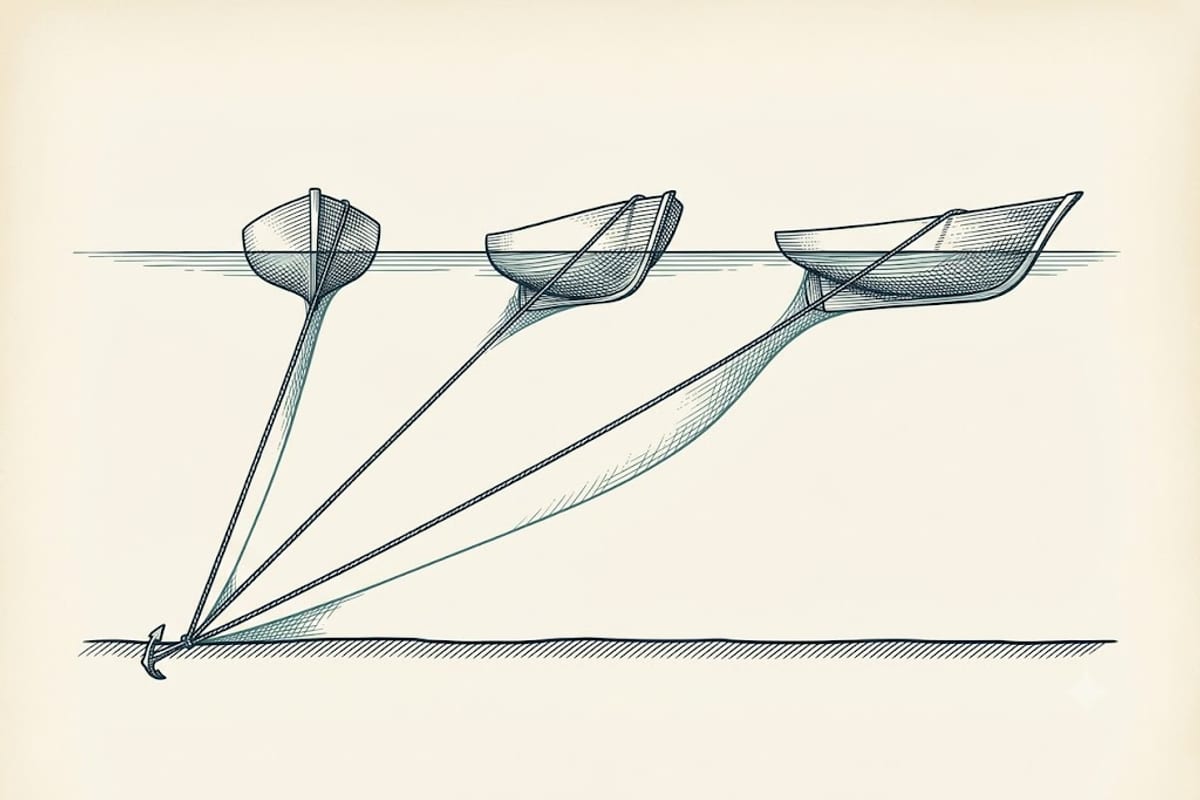
Every anchor design assumes a near-horizontal pull. Pull horizontally and the anchor digs deeper as load increases — it is self-setting. Pull upward and you are levering it out of the bottom, which is exactly how anchors are recovered on purpose.
The geometry:
| Scope | Angle at the anchor |
|---|---|
| 3:1 | ~19° |
| 5:1 | ~11° |
| 7:1 | ~8° |
| 10:1 | ~6° |
The gain from 3:1 to 5:1 is large. From 7:1 to 10:1 it is small. That flattening is why 7:1 became the traditional figure — past it you are consuming swinging room for very little.
Why all-chain gets away with 5:1
Chain is heavy, so it sags into a curve — a catenary — between bow and anchor. That sag means the last section of chain lies along the seabed and pulls horizontally regardless of scope, which is what the ratio was trying to achieve geometrically.
So 5:1 all-chain in settled conditions is not a corner cut; it is a different route to the same pull angle.
But the catenary straightens under load. In a strong blow the wind pulls the chain taut, the curve disappears, and you are back to pure geometry — at 5:1, with an 11° pull instead of 8°, in exactly the conditions where you wanted more margin.
This is the single most important thing to understand about all-chain rode: the advantage is largest when you need it least. Which is why the numbers below are conditional.
Working figures
- 3:1 — lunch stop only. Someone aboard, engine ready, settled weather.
- 5:1 — all-chain, settled conditions, overnight.
- 7:1 — rope or mixed rode; or all-chain when weather is expected.
- 10:1 — heavy weather, if the anchorage has room.
More scope is nearly always better and nearly always constrained by something else.
What limits it
Swinging room. Your boat can end up anywhere on a circle of radius equal to rode out plus boat length. At 100 ft of rode on a 30 ft boat, that circle is 260 ft across. In a crowded anchorage, more scope means negotiating with neighbours.
Boats on different rodes swing differently. An all-chain boat and a rope-rode boat in the same anchorage respond to a wind shift at different rates and to different radii. Anchoring close to a boat on a very different rode is how two boats that were fine at dusk touch at three in the morning.
Depth. In 60 ft of water, 7:1 is 420 ft of rode — more than many boats carry. Deep anchorages force lower ratios, and that is a real reason to prefer a bay you can anchor properly in.
Set it, then check it
Scope is one of three things that decide whether you hold. The others are an anchor suited to the bottom — see anchor types by bottom — and actually setting it rather than assuming it set.
Take a transit ashore, two fixed objects in line, and watch whether they stay lined up. That is the measurement that tells you the truth.
FAQ
What does 7:1 scope mean?
Seven feet of rode for every foot of vertical distance from the seabed to your bow roller, including the tide still to come.
Is 5:1 scope enough?
With all-chain in settled conditions, generally yes — the chain's catenary keeps the pull horizontal. In strong wind the catenary straightens out and you want more.
Do I measure scope from the water surface?
No. From the seabed to the bow roller — depth plus remaining tidal rise plus bow height.
Why does more scope help?
It flattens the angle the rode pulls at the anchor. A horizontal pull makes an anchor dig in; an upward pull levers it out.
How much room will my boat need?
Rode paid out plus boat length, as the radius of a circle. At 100 feet of rode a 30-foot boat needs a circle 260 feet across.