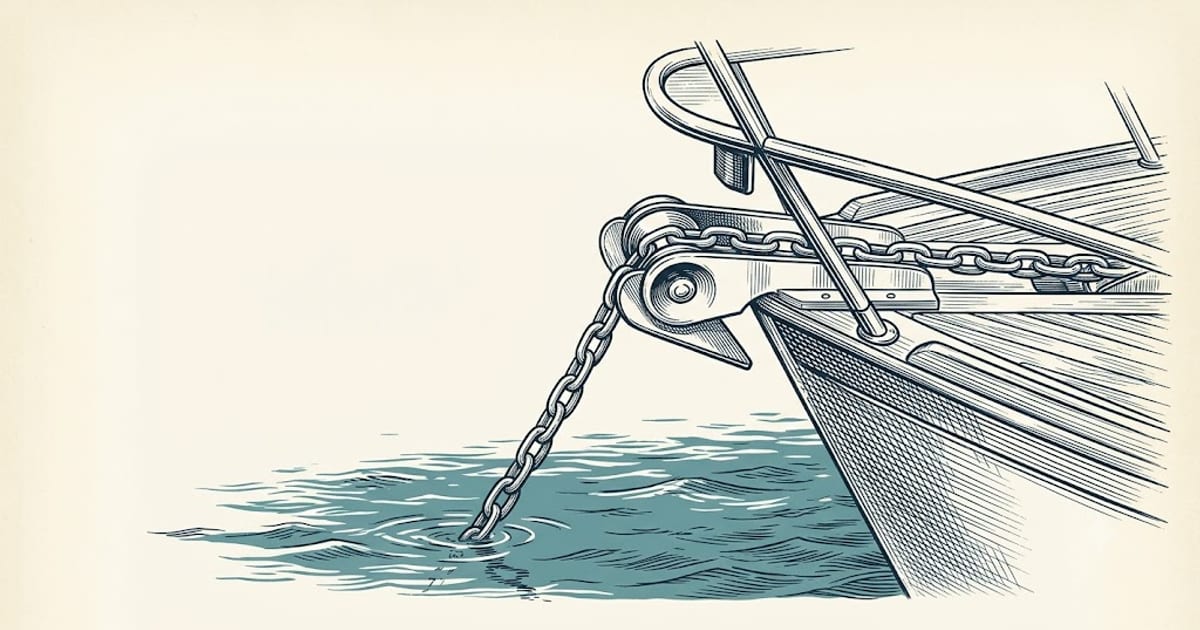
The rule everyone knows is 7:1. The part that gets left out is 7:1 of what.
Scope is measured from the bow roller to the seabed, not from the waterline. It has to include the tide that will arrive later. Getting this wrong is systematic — it always produces too little rode, never too much.
The number scope multiplies
Rode = scope × (depth + tidal rise + bow height)
- Depth — what the sounder reads, and check whether yours is set to read from the surface or from under the keel.
- Tidal rise — the height still to come between now and high water, not the full range.
- Bow height — from waterline to the bow roller. On a small boat this is 3 feet; on a larger cruiser it can be 6 or more.
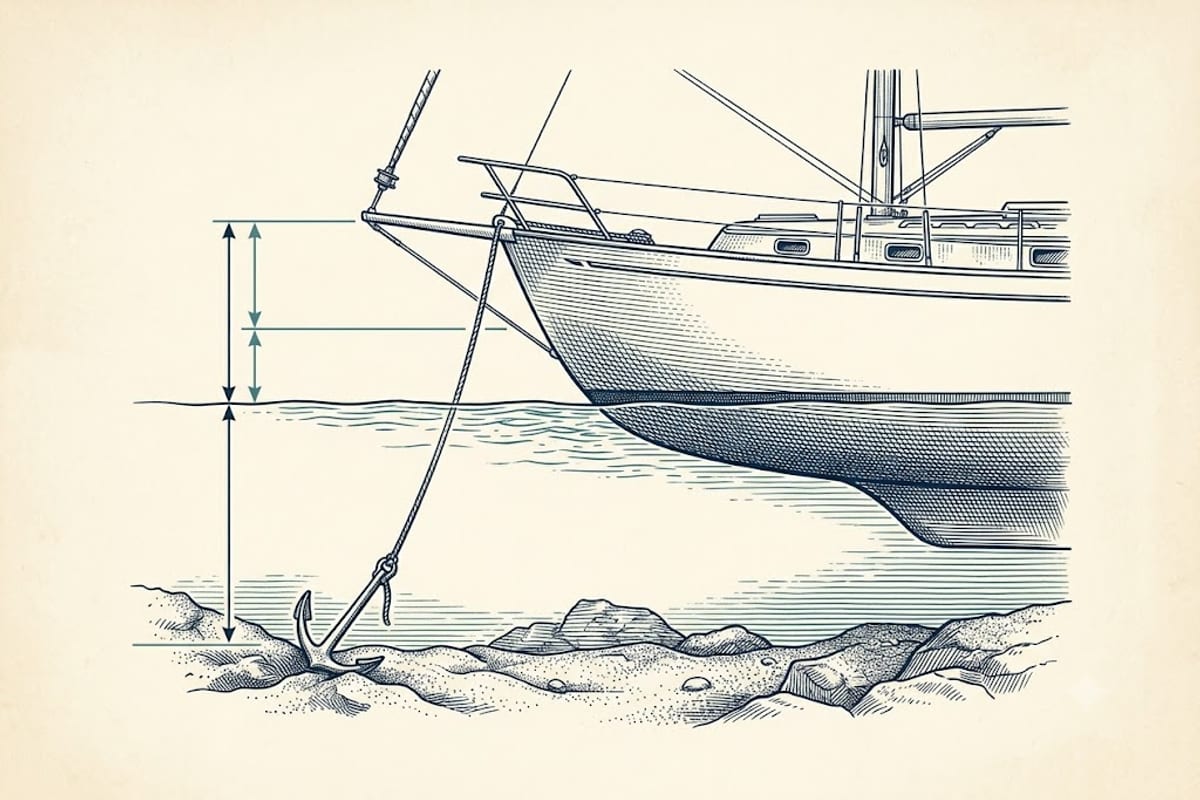
Anchoring in 15 feet with 5 feet of tide to come and a 4-foot bow is not a 15-foot problem. It is 24 feet, and at 7:1 that is 168 feet of rode, not 105.
That 63-foot gap is the difference between holding and dragging at two in the morning, and it is the single most common arithmetic mistake in anchoring.
How much scope
7:1 is the traditional figure and it comes from rope rode, where the catenary is minimal and the angle at the anchor depends almost entirely on length.
All-chain changes the picture. Chain's weight makes the rode sag into a curve that pulls more horizontally at the anchor, which is exactly what a scope ratio is trying to achieve. Most cruisers with all-chain work to 5:1 in settled conditions.
In practice:
- 5:1 all-chain, settled — common working figure.
- 7:1 — rope or mixed rode, or a night you would like to sleep through.
- 10:1 — heavy weather, if there is room to swing.
- 3:1 — lunch stop, someone aboard, engine ready. Not overnight.
The constraint is usually the anchorage rather than the arithmetic. More scope means a bigger swinging circle, and in a crowded anchorage that is a negotiation with the boats around you.
How much of it should be chain
Chain does three things rope cannot: it resists chafe on rock and coral, its weight flattens the pull angle at the anchor, and it does not float into a propeller.
Common approaches:
- All chain — standard on cruising boats with a windlass. Heaviest and most expensive, and it puts all that weight in the ends of the boat.
- Mixed rode — a length of chain at the anchor with nylon behind it. A widely used starting point is a boat length of chain, or about one foot of chain per foot of boat.
- All rope with a short leader — light, cheap, and fine for lunch hooks and light-displacement boats.
Chain size by boat length, approximately:
| Boat length | Chain |
|---|---|
| Under 28 ft | 1/4 in |
| 28–40 ft | 5/16 in |
| 40–50 ft | 3/8 in |
Nylon, and why three-strand
If any part of the rode is rope, it should be nylon, and three-strand rather than braid. Nylon stretches, and that stretch is the only shock absorption in the entire system.
An all-chain rode has essentially none, which is why boats using it need a snubber — a length of nylon taking the load from the chain to a cleat, so that gusts stretch a rope rather than jerking the anchor. Skipping the snubber transmits every snatch load straight to the anchor and to the bow fitting.
The snubber also takes the load off the windlass, which is not designed to hold it. More on that in windlass sizing.
FAQ
How much anchor rode do I need?
Scope multiplied by the total of depth, remaining tidal rise and bow height. For a typical coastal boat, 150 to 200 feet is a common minimum, and more if you anchor in deep water.
Is 5:1 scope enough?
With all-chain in settled conditions, generally yes. With rope rode, work to 7:1 — rope lacks the weight that makes chain pull horizontally at the anchor.
Do I measure depth from the surface or the keel?
From the surface, then add bow height as well. Check what your sounder is calibrated to, because many are set to read depth below the keel.
How much chain should I have on a mixed rode?
A common starting point is one foot of chain per foot of boat, or at least a boat length. The chain's job is chafe resistance at the bottom and a flatter pull angle.
Why do I need a snubber with all-chain?
Chain does not stretch, so gusts and waves transmit shock loads directly to the anchor and the bow fitting. A nylon snubber absorbs them, and it also keeps the load off the windlass.