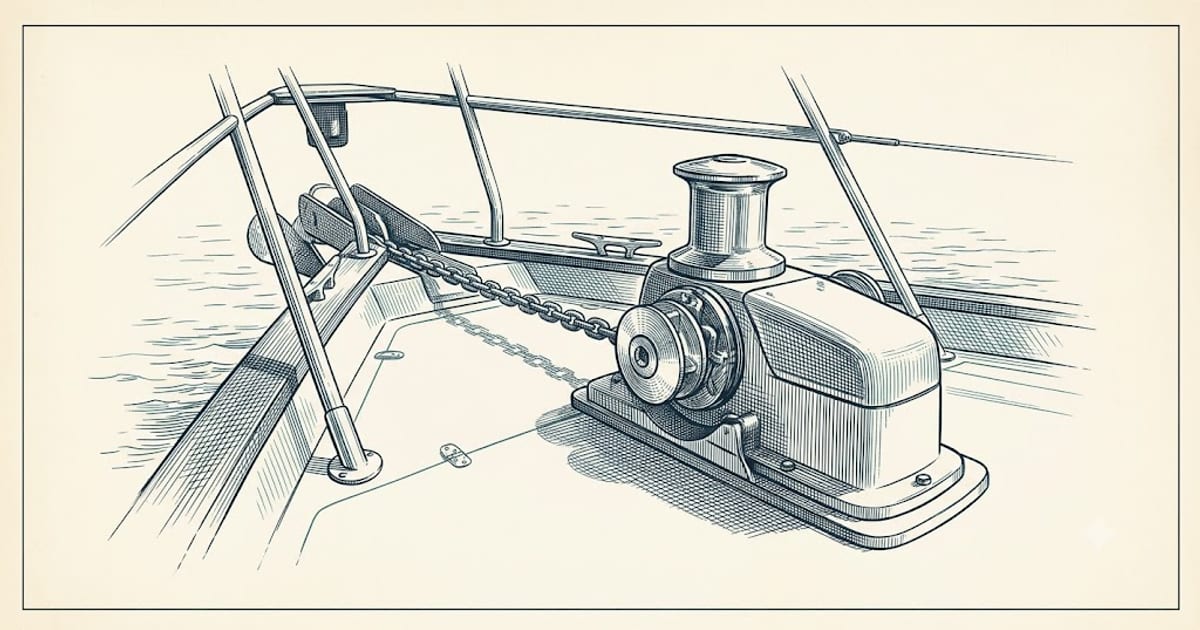
A windlass is not sized against the anchor. It is sized against everything the anchor is attached to, because on retrieval the motor lifts the whole lot at once.
The 3× rule
Working load = 3 × (anchor + all chain + all rode + shackles)
Three times, not one, and the multiplier covers the things that make a real retrieval harder than a static weight: mud stuck to the anchor and chain, the boat pitching in a swell, and the pull needed to break the anchor out of the bottom.
Worked through for a mid-size cruiser:
| Item | Weight |
|---|---|
| Anchor | 45 lb |
| 200 ft of 5/16 in chain | ~230 lb |
| 100 ft nylon | ~10 lb |
| Shackles and swivel | ~5 lb |
| Total ground tackle | ~290 lb |
| Windlass working load | ~870 lb |
The chain dominates, and it dominates by a lot. This is why adding chain to an existing setup can quietly put the windlass out of its range — the anchor never changed, but the number that matters tripled.
The gypsy is where it actually goes wrong
The gypsy — the toothed wheel the chain sits in — has to match your chain in size and standard, and "5/16 inch" does not settle it.
Different chain standards with the same nominal size have different pitch and different link dimensions: G4/G43 high test, BBB, proof coil and ISO calibrated chain are not interchangeable in a gypsy cut for one of them.
A mismatch does not fail cleanly. It produces chain that rides up and jumps out of the gypsy under load, usually while someone's hands are near it. That is a genuine injury risk, not just an annoyance.
Buy the chain and the gypsy as a matched decision. If you are replacing chain on an existing windlass, match the standard exactly — not just the size — and if you cannot identify what is fitted, measure the pitch over ten links rather than guessing from the label.
Vertical or horizontal
Vertical windlasses put the motor below deck, leaving a clean foredeck. They need adequate fall — the vertical drop from the gypsy into the locker — for the chain to stack itself rather than piling into a cone that jams. Roughly 12 inches of fall is a common minimum, and less than that means someone goes forward to knock the pile down.
Horizontal windlasses sit entirely on deck, need less fall, and are easier to service. They take up deck space and are more exposed to weather.
The deciding factor is usually chain locker depth rather than preference.
Wiring is not an afterthought
Windlasses draw current in a way little else on a small boat does — hundreds of amps at peak on larger units, from a battery that is typically at the opposite end of the boat.
Undersized cable does not stop the windlass working; it produces voltage drop, which means the motor turns slowly, works harder and gets hot. People diagnose this as a weak windlass and buy a bigger one.
Size the cable for the run length and the peak draw, fit a properly rated breaker or fuse near the battery, and give the windlass a dedicated circuit. Many installations also justify a battery at the bow.
A windlass is not a cleat
This one is simple and gets ignored. The windlass holds the chain while it is being moved. It is not designed to take the anchoring loads of a boat lying to its anchor overnight.
Once anchored, take the load onto a snubber or bridle made off to a cleat, and leave slack chain between it and the windlass. Skipping this transmits every snatch load into the gypsy, the shaft and the deck it is bolted to.
The snubber is covered along with rode makeup in how much rode to carry.
FAQ
What size windlass do I need?
Three times the combined weight of anchor, all chain, all rode and hardware. On most boats the chain is the largest part of that total.
Why does my chain jump out of the gypsy?
Almost always a chain and gypsy mismatch. Nominal size is not enough — chain standards differ in pitch and link dimensions, and a gypsy cut for one will not hold another.
Vertical or horizontal windlass?
Vertical if the chain locker has enough fall, typically about 12 inches below the gypsy, and you want a clear foredeck. Horizontal if the locker is shallow or you want easier servicing.
Can I anchor overnight on the windlass?
No. Take the load onto a snubber or bridle at a cleat and leave the chain slack into the windlass. The windlass is for moving chain, not holding the boat.
Why is my windlass slow?
Usually voltage drop from undersized cable over a long run, not a weak motor. Check cable size and connections before replacing the unit.