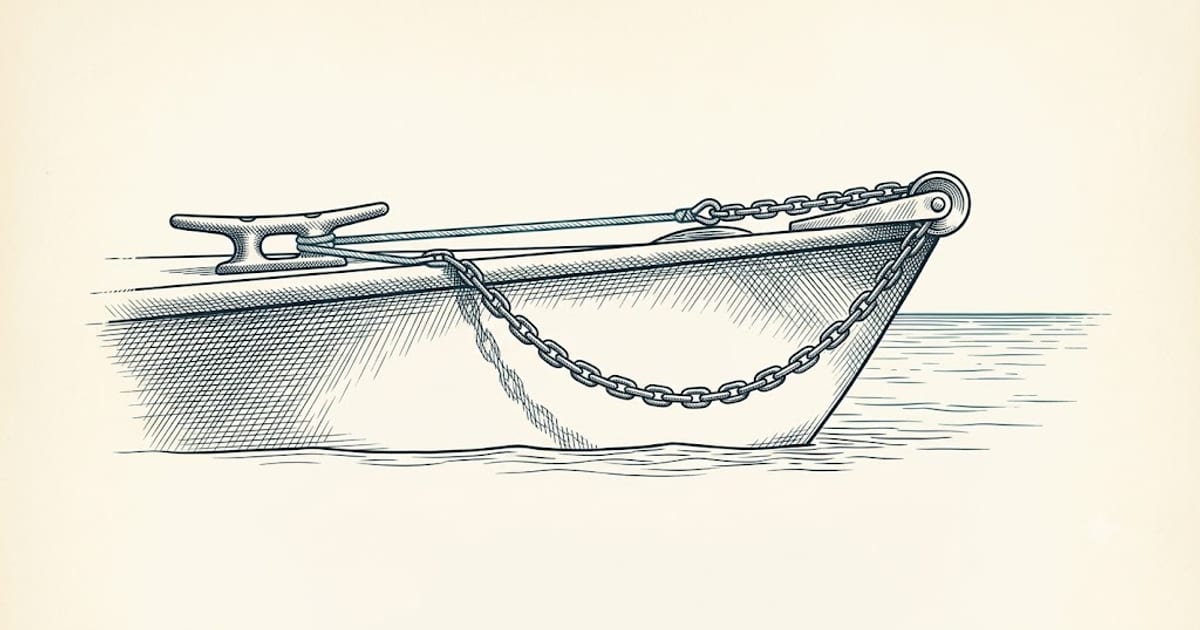
An all-chain rode has no stretch. When the bow rises in a chop and the chain comes taut, the shock goes somewhere — into the anchor, into the bow roller, into the deck the windlass is bolted to.
A snubber is a length of nylon that takes the chain's load and stretches instead. Everything downstream of it stops seeing snatch loads.
How it works
Attach nylon to the chain forward of the bow roller, make the other end fast to a cleat, then pay out more chain so a loop of it hangs slack below.
Now the load path runs chain → snubber → cleat, with the chain bypassed. The nylon absorbs the shock, and the windlass is out of the load path entirely — which matters, because a windlass is designed to move chain, not to hold a boat.
Length and diameter
Length is what provides the stretch, and more is better within reason. Nylon stretches by a percentage of its length, so a 25 ft snubber absorbs far more than a 6 ft one. Something in the region of 20 to 30 feet is a common working length for a cruising boat.
Diameter should be sized so the line actually stretches. Oversized nylon is stiff and does not elongate under the loads involved — a snubber too thick does almost nothing, which is a common and invisible mistake. Sized close to your primary dock line diameter is a reasonable place to start.
Three-strand nylon, not braid. Three-strand stretches more, and stretch is the entire point.
Attaching to the chain
Chain hook — quick and easy, the usual choice. Can shake loose when the snubber goes slack in a lull, then snap on again. Some hooks are designed to resist this better than others.
Rolling hitch — grips reliably and will not fall off, but takes longer and must be tied correctly.
Soft shackle or dedicated chain grab — middle ground.
Whatever you use, the load must come onto the snubber gradually as you pay out the slack chain, not all at once.
Bridles
A bridle is a snubber with two legs, one to each bow.
On a catamaran it is not optional — the load has to be shared between two hulls.
On a monohull it reduces yawing. A boat lying to a single point wanders from side to side in a breeze, and each swing ends with a jerk as the rode comes taut off-centre. Attaching two legs to cleats either side damps that motion considerably.
More stable nights, less shock loading, and it costs a second line.
Chafe is where snubbers fail
The failure point is almost always where the snubber passes over the bow roller or through a chock. Nylon under repeated tension against metal wears fast — and it wears fastest in exactly the conditions where it is doing most work.
Fit chafe protection: a length of hose split over the line, purpose-made chafe gear, or heavy cloth lashed in place. Check it in the morning after a rough night, and check the position too — the wear point moves as the boat swings.
Carry a spare snubber made up and ready. Replacing one at three in the morning in a rising wind is not the moment to be measuring and splicing.
FAQ
Do I need a snubber with all-chain rode?
Yes. Chain does not stretch, so without one every gust transmits a shock load directly to the anchor, the bow fitting and the windlass.
How long should an anchor snubber be?
Roughly 20 to 30 feet for a typical cruising boat. Stretch is proportional to length, so longer absorbs more.
What size line for a snubber?
Sized so it actually stretches under load — around your primary dock line diameter. Oversized nylon is too stiff to elongate and does almost nothing.
Snubber or bridle?
A bridle is essential on a catamaran and reduces yawing on a monohull. A single snubber is adequate for most monohulls in settled conditions.
Where do snubbers chafe?
Where they pass over the bow roller or through a chock. Fit chafe protection and check it after any rough night.