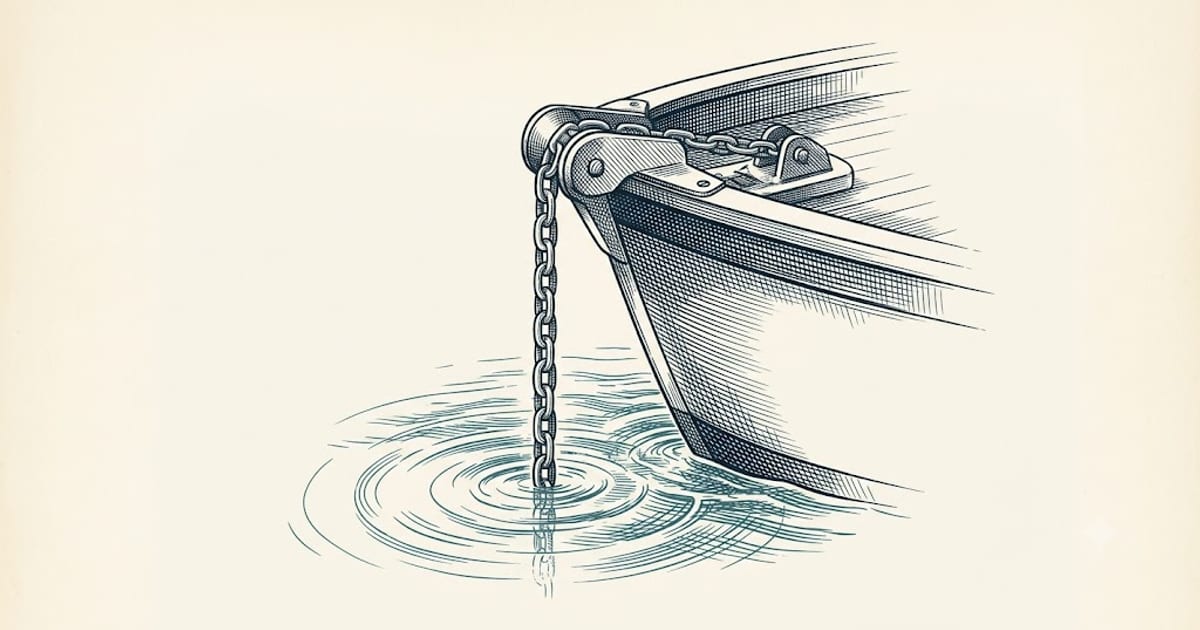
An anchor that will not come up is usually buried deeper than it needs to be, or hooked under something.
The instinct is to keep winding. That is the one method guaranteed to break something, because a windlass is designed to lift chain, not to break out an anchor. Deck fittings, gypsy teeth and gearboxes all fail this way.
The sequence
1. Motor slowly up over the anchor, taking in rode as you go until it leads straight down.
2. Snub it short and cleat it. Take the load onto a cleat, not the windlass.
3. Let the boat do the work. A boat has enormous buoyancy. With the rode vertical and made fast, forward motion or the rise of a passing swell applies far more upward force than any winch — and it applies it as a series of pulls rather than a steady strain.
In any swell at all, this alone frees most anchors within a few minutes.
4. If it holds, change the direction of pull. Motor slowly in a circle around the anchor, keeping the rode short. Anchors bury facing one way and come out easily backwards; often a quarter turn is enough.
5. Motor gently ahead past the anchor with the rode short and cleated. Pulling from the opposite side to the way it set is the most effective single manoeuvre.
What not to do
Do not use the windlass to break it out. Its job starts once the anchor is free.
Do not surge the boat hard against a cleated rode. Snatch loading an all-chain rode with the full weight of the boat behind it can damage the bow fitting or the anchor. Firm and steady, not a run-up.
Do not send anyone into the water to free it without thinking hard about depth, current, boat traffic and what happens if it releases suddenly.
The trip line prevents all of this
A trip line is a light line from the anchor's crown to a small float on the surface. Pull the crown and the anchor comes out backwards, however it is hooked.
Rig one whenever anchoring in rock, coral, or ground known to be foul — old moorings, cables, debris. It costs a minute at the start and saves the entire problem.
Two cautions. The float looks like a mooring buoy to other boats, and someone will eventually try to tie to it. And a trip line long enough to reach the surface at high water can foul your own propeller when the boat swings.
If it is genuinely fouled
An anchor hooked under a cable, chain or old mooring may not come out by any of the above.
Options: a chain collar or anchor retrieval ring slid down the rode to reach the crown; a diver, where depth and conditions allow; or, in the worst case, buoying the rode and leaving it to be recovered later rather than losing the boat's position and daylight to it.
Which is one more argument for the trip line in ground you do not know.
FAQ
How do I free a stuck anchor?
Motor up until the rode is vertical, cleat it short, and let the boat's buoyancy and any swell break it out. Then change the pull direction by circling.
Can I use the windlass to pull out a stuck anchor?
No. A windlass lifts chain; breaking out an anchor with it damages the gypsy, gearbox or the deck it is mounted to.
What is an anchor trip line?
A light line from the anchor's crown to a surface float, letting you pull the anchor out backwards when it is hooked.
When should I rig a trip line?
Anchoring in rock, coral or ground known to be foul with old moorings, cables or debris.
Why does circling the boat help?
Anchors bury facing one direction and release easily when pulled from the opposite side. Changing the pull direction is often enough on its own.