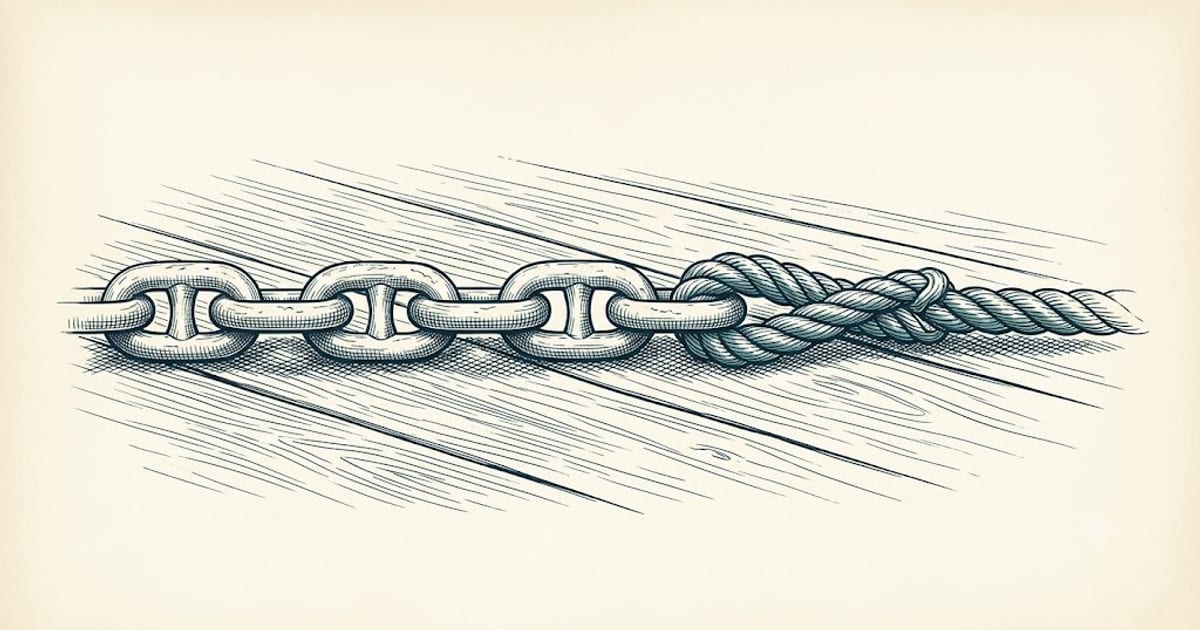
The two materials solve different halves of the same problem and each creates the other's weakness.
| Chain | Nylon three-strand | |
|---|---|---|
| Chafe resistance | excellent | poor on rock and coral |
| Weight and catenary | high — flattens pull angle | negligible |
| Stretch / shock absorption | none | excellent |
| Cost | high | low |
| Handling | needs a windlass | by hand |
| Floats into propellers | no | yes |
What chain buys
Chafe resistance at the bottom. The section nearest the anchor drags across rock, coral and shell. Nylon there wears through — sometimes in a single night in the wrong bottom.
Catenary. Chain's weight makes the rode sag into a curve, so the last part lies along the seabed and pulls horizontally. That is exactly what scope ratio exists to achieve, which is why all-chain boats can work to lower ratios in settled conditions — with the caveat covered in anchor scope.
It does not float. A nylon rode gone slack can find a propeller. Chain cannot.
What chain costs
No stretch at all. This is the serious one. In a chop, every time the bow rises, an all-chain rode with the catenary pulled out transmits a snatch load directly to the anchor and to the bow fitting. Nothing in the system absorbs it.
That is what a snubber is for — a length of nylon from the chain to a cleat, with slack chain behind it. The nylon stretches; the shock never reaches the anchor. On an all-chain boat a snubber is not an accessory, it is the missing component.
Weight, in the worst place. Two hundred feet of 5/16 in chain is over 200 lb, carried right in the bow where it affects pitching most.
It needs a windlass. Which brings its own sizing, wiring and gypsy-matching problems — see windlass sizing.
Mixed rode: the common compromise
A length of chain at the anchor with nylon behind it. Chain handles the chafe and helps the angle; nylon provides stretch, weight saving and cost.
A widely used starting point is one foot of chain per foot of boat, or at least a boat length. More chain in rocky cruising grounds, less on a light boat that anchors in sand.
The join matters. A rope-to-chain splice passes through a windlass gypsy; a shackle does not. If you have a windlass, splice it.
Choosing
All chain — cruising boats with a windlass, rocky or coral bottoms, anchoring overnight regularly. Fit a snubber and use it every time.
Mixed rode — most boats in the 25–40 ft range. Best balance of cost, weight and capability.
All rope with a short chain leader — light displacement, day anchoring, lunch hooks, boats without a windlass. Inspect the leader for chafe after rocky bottoms.
Sizing either is in how much rode to carry.
FAQ
Is all-chain rode better than rope?
Better on chafe and pull angle, worse on shock loading because it does not stretch. All-chain systems need a nylon snubber to compensate.
How much chain should a mixed rode have?
A common starting point is one foot of chain per foot of boat length, or at least a boat length.
Why do I need a snubber with all chain?
Chain has no stretch, so gusts and waves transmit shock loads straight to the anchor and bow fitting. Nylon absorbs them.
What rope should be used for anchor rode?
Three-strand nylon. It stretches more than braid, and stretch is the entire reason rope is in the system.
Should I splice or shackle rope to chain?
Splice if you have a windlass — a splice passes through the gypsy and a shackle will not.