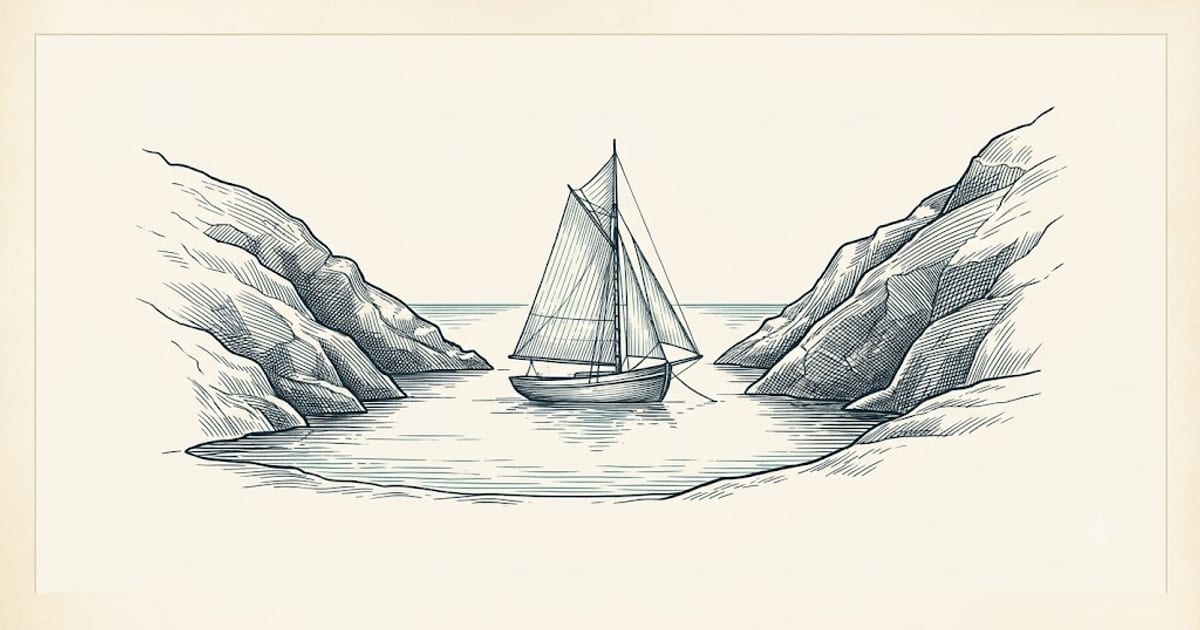
Most nights, one anchor set properly is better than two set hastily. Two rodes tangle, complicate recovery, and double what has to go right.
Each of the three arrangements below solves one specific problem.
Bahamian moor — reversing current
Two anchors set in opposite directions, both from the bow, with the boat lying between them.
The problem it solves: a tidal river or narrow channel where the current reverses. On a single anchor the boat swings 180° twice a day and the anchor must re-set each time — the moment things go wrong. With a Bahamian moor one anchor takes the load on each tide and neither needs to re-set.
It also dramatically reduces the swinging circle, which is why it appears in crowded, narrow anchorages.
Setting it: drop the first anchor, fall back on double the intended scope, drop the second, then take in on the first until you lie midway with both rodes tight.
Forked moor — wind, not current
Two anchors from the bow at roughly 45–60° apart, both ahead.
This shares load between two anchors and limits swing in a blow. Useful when strong wind is forecast and the anchorage is tight.
The catch: if the wind shifts far enough, both rodes end up on the same side and can wrap. A forked moor wants attention rather than a night's sleep.
Stern anchor — holding a heading
One anchor from the bow, one from the stern, holding the boat in a fixed orientation.
Used to keep a bow into swell that is running across the wind, to hold position in a very narrow creek, or to keep the boat off a beach or dock.
It removes the boat's ability to weathercock. Beam-on to a rising wind, the loads become much larger than a boat lying head to wind ever sees, and the stern is usually less able to take them. A stern anchor is a settled-weather arrangement.
Tandem — heavy weather
Two anchors on the same rode, in line, the second shackled to the crown of the first. Both bury, and the leading one holds the second down.
Genuinely effective in storm conditions, and awkward to recover. Rig it before the weather, not during.
When to stay with one
For most overnight anchoring, a correctly sized modern anchor at adequate scope, properly set and checked with a transit, outperforms two anchors set carelessly.
The sequence that matters is in how to set an anchor, and the scope arithmetic in anchor scope.
Where a second anchor genuinely earns its stowage is as a different type for a bottom the primary handles poorly — see anchor types by bottom. A second anchor of the same design covers nothing the first does not.
FAQ
What is a Bahamian moor?
Two anchors set in opposite directions from the bow, so the boat lies between them. Used where tidal current reverses, and it greatly reduces the swinging circle.
When should I use two anchors?
For reversing current, for heavy weather in a tight anchorage, or to hold a specific heading. For ordinary overnight anchoring, one set properly is better.
Is a stern anchor safe in strong wind?
No. It stops the boat lying head to wind, and beam-on loads rise sharply. Treat it as a settled-weather arrangement.
What is a tandem anchor setup?
Two anchors in line on the same rode, the second shackled to the crown of the first. Effective in storms and awkward to recover.
Should my second anchor be the same type?
No. A different type covers the bottoms your primary handles poorly, which is the main reason to carry one.