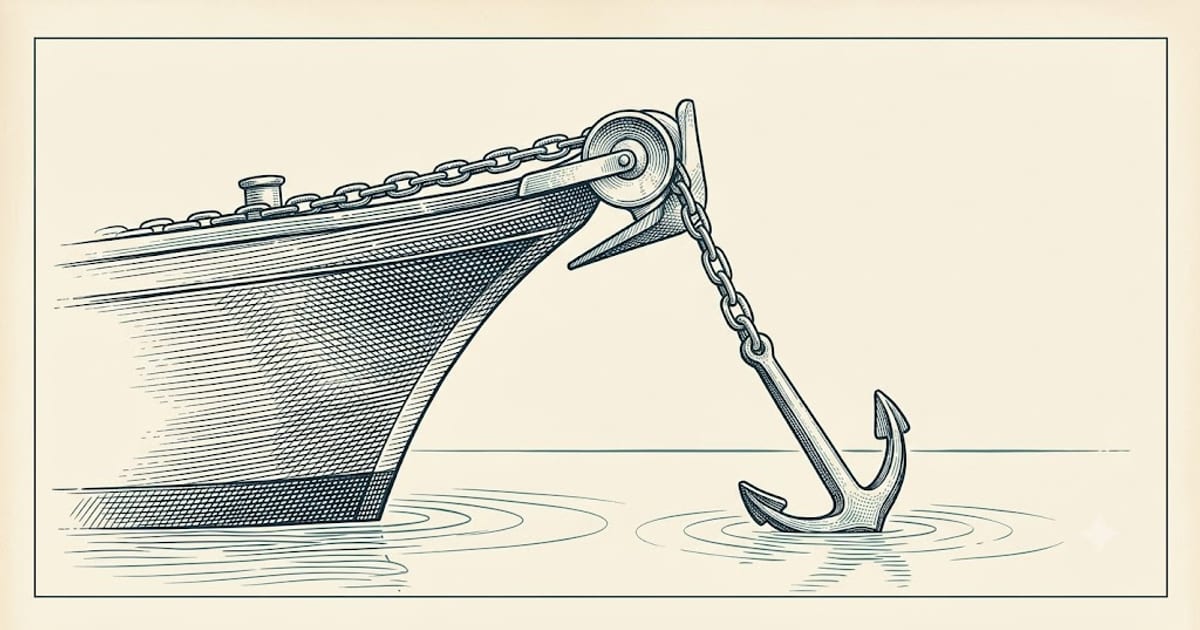
An anchor that never set will drag on the first wind shift, hours later, in the dark. It felt fine at the time because nothing was pulling on it.
Setting is a procedure, and it ends with a check.
The sequence
1. Choose the spot and check depth. Note the depth, work out your scope target, and confirm you have swinging room from every direction the wind might come. Look at where the boats around you sit and what rode they are on.
2. Approach into wind or current, whichever is stronger, and stop the boat over the spot. Stopped, not drifting.
3. Lower the anchor — do not throw it. Lower under control until it touches bottom. Throwing lands the anchor with chain piled on top of it, which is the classic way to foul it before you begin.
4. Drift back, paying out rode as you go. Let the boat move astern under wind or a touch of reverse, feeding rode so it lays out along the seabed rather than heaping. Pay out steadily, matching the boat's movement.
5. When the target scope is out, snub the rode — make it fast — and let the boat's weight come onto it gently.
6. Back down progressively. Idle astern first, then increasing power over a minute or two. Slowly. The point is to load the anchor gradually so it digs in.
Why backing down hard too early fails
An anchor sets by burying itself as load increases. That takes time and it takes distance travelled through the bottom.
Slam it with full reverse immediately and you drag it along the surface of the seabed rather than into it. Soft mud is the worst case — the anchor planes along near the top and never reaches the firmer material underneath.
The correct feeling is the boat coming to a stop and staying stopped as power increases. If the boat keeps moving astern with the rode taut, the anchor is dragging, and no amount of extra power will change that. Recover and start again.
Prove it with a transit
The check that matters is not the chain angle or the feel of the rode. It is whether the boat is moving.
Find two fixed objects ashore that line up — a tree in front of a building, a headland behind a mark. Watch them while backing down. If they stay in line, you are stationary. If they separate, you are moving.
A transit is far more sensitive than looking at a single object, and more reliable than a GPS anchor alarm in the first minutes, since GPS wander at anchor is normal and takes time to distinguish from real movement.
Set a GPS anchor alarm afterwards for the night, but set the transit first.
Two things people skip
Snubber on all-chain. Chain has no stretch, so every gust is transmitted straight to the anchor and the bow fitting. A nylon snubber takes the load and absorbs the shock — see windlass sizing for why keeping the load off the windlass matters too.
A second look after twenty minutes. Anchors sometimes set, then reset as the boat settles onto a slightly different heading. Check the transit again before going below.
If it will not set
Two failed attempts in the same spot means the bottom is the problem, not the technique. Move.
Weed defeats anchors by preventing them touching the seabed at all. Hard sand and shell can skate. Which anchor suits which bottom is in anchor types by bottom.
FAQ
How do I know if my anchor is set?
Back down with increasing power and watch a transit ashore — two fixed objects in line. If they stay lined up, you are holding.
Should I throw the anchor overboard?
No. Lower it under control. Throwing piles the chain on top of the anchor and fouls it.
How hard should I back down on the anchor?
Progressively — idle first, then increasing over a minute or two. Full power immediately drags the anchor along the bottom instead of setting it.
Why does my anchor drag at night?
Usually because it never set properly. It held against the light load at the time and released at the first real pull or wind shift.
How long should I wait before leaving the boat?
Check the transit again about twenty minutes after setting. Anchors can reset as the boat settles onto a different heading.