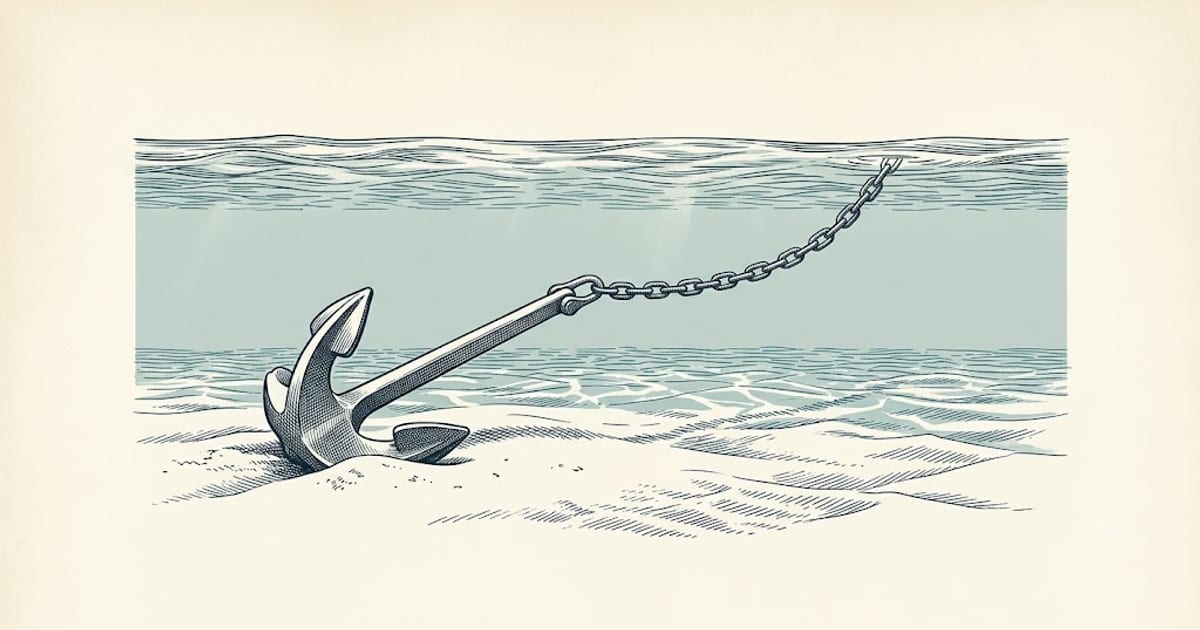
Anchor charts size by boat length, and boat length is the one variable that does not change while you are anchored. The seabed does, from one bay to the next, and it moves holding power by far more than a size up or down ever will.
The same anchor that holds solidly in firm sand can be close to useless in soft mud or weed. That is not a defect — it is the physics of how each type generates resistance.
Sand: the easy case
Firm sand is where nearly everything works, and where published holding figures are measured.
Fluke anchors (Danforth type) excel here. They are almost pure surface area, and once the flukes dig in, the resistance for their weight is exceptional — better, pound for pound, than anything else.
Modern scoop anchors (Rocna, Mantus, Spade and similar) set fast and deep in sand and re-set reliably if the boat swings.
If you anchor mostly in sand, a fluke anchor gives more holding per pound of stowed weight than anything else. Its weaknesses show up elsewhere. See fluke anchors for where those are.
Mud: penetration beats surface area
Soft mud is where the sand ranking inverts.
Holding in mud comes from getting deep enough to reach firmer material underneath. A wide, flat anchor tends to plane along near the surface of the mud rather than dig through it — which is exactly what a fluke anchor's geometry encourages.
Scoop anchors with a sharp, weighted toe do better because they are shaped to keep driving downward. Fluke anchors intended for mud have mud palms — small plates that trip the flukes into a digging angle rather than letting them skate.
Set slowly in mud. Dragging back hard immediately tends to pull the anchor along rather than down.
Grass and weed: the hardest bottom
Weed defeats anchors by preventing them from ever touching the seabed. The anchor sits on a mat of vegetation, the mat tears under load, and the boat moves.
What helps:
- Weight and a sharp toe. The anchor has to cut through rather than rest on top.
- Setting slowly, giving it time to penetrate.
- Checking the set properly, because a weed-fouled anchor can feel set and then release all at once.
What does not help: more scope alone. If the anchor is on top of the weed, geometry is not the problem.
Rock: hooking rather than burying
In rock, no anchor buries — holding comes from wedging or hooking on something.
Claw anchors (Bruce type) find purchase in rock and rubble reasonably well. Grapnels hook, which is why they suit small craft in rocky ground.
Two things follow. Use chain at the anchor end, because rope over rock chafes through quickly. And expect to work at recovery — a trip line to the crown is worth rigging if you may need to pull the anchor out backwards.
Shell, gravel and coral
Shell and gravel are inconsistent: sometimes an anchor bites, sometimes it skates across. There is no type that reliably solves it, so what matters is checking the set rather than assuming it.
Coral should not be anchored in at all where it can be avoided. It damages the reef and it fouls anchors badly.
What this means for choosing
Most cruisers carry one primary anchor sized generously, and choose the type by the bottom they see most:
- Mostly sand — fluke, or a scoop.
- Mixed sand and mud — a scoop anchor. This is why they have become the cruising default.
- Weed and rock in the mix — a heavy scoop, and a second anchor of a different type.
A second anchor of the same type adds little. A second anchor of a different type covers the bottom the first one is bad at, which is the entire reason to carry one.
Sizing is covered in anchor sizing for boats, and how much rode to pair with it in rode length.
FAQ
What is the best all-round anchor?
A modern scoop type. They set fast in sand, penetrate mud adequately, and re-set reliably when the boat swings — which is why they have displaced older designs as the cruising standard.
Why won't my anchor hold in mud?
Most likely it is planing along near the surface rather than digging down. Holding in soft mud comes from depth. Set slowly, and consider an anchor with a sharp weighted toe or mud palms.
Are fluke anchors any good?
Excellent in firm sand, where they give more holding per pound than anything else. Poor in weed and rock, and they do not reliably re-set if the boat swings.
What anchor works in a weedy bottom?
A heavy anchor with a sharp toe that can cut through the mat, set slowly. Weed is the bottom where a second anchor of a different type earns its stowage.
Does more scope fix poor holding?
Only when the problem is pull angle. If the anchor is sitting on top of weed or skating over gravel, more scope changes nothing.