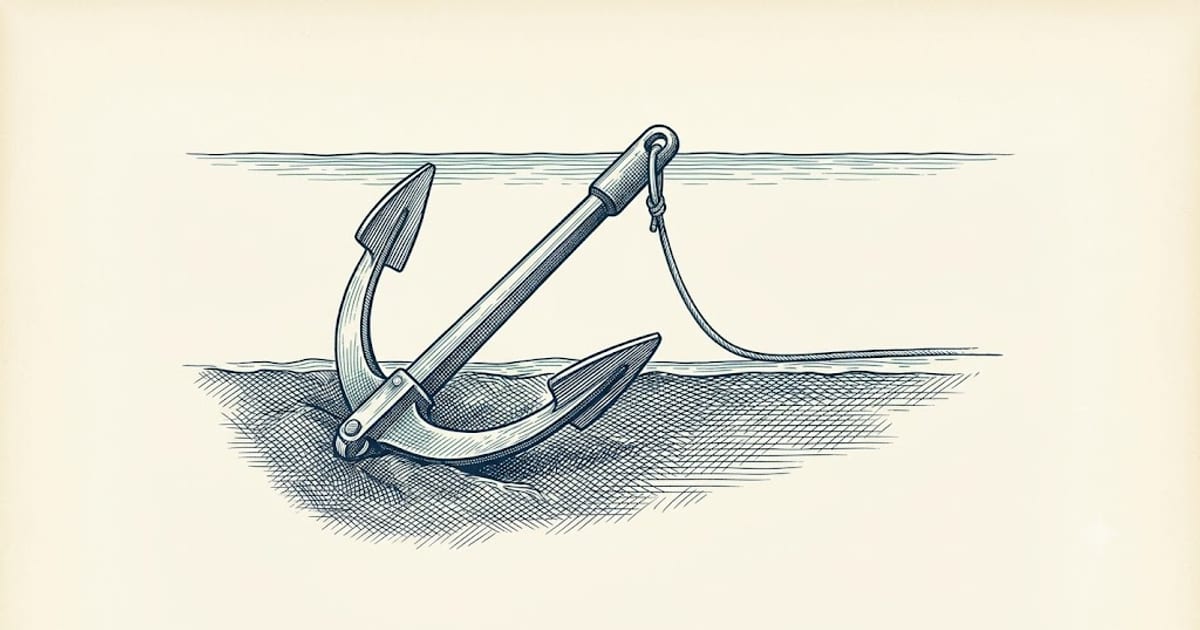
The fluke anchor — two broad flat blades hinged to a shank, with a stock across the crown — has the best holding-to-weight ratio of any common design in the bottom it likes. It is also the design most likely to be lying uselessly on its side in the bottom it does not.
The sizing principles are in the anchor sizing page.
How it works
The blades pivot relative to the shank within a limited range. When the rode pulls horizontally, the blade tips catch and the geometry drives the whole anchor down into the bottom. In soft ground it buries completely, and the holding comes from the mass of bottom material above the blades — which is why a light fluke anchor holds so much.
The stock across the crown stops it rolling and forces the blades to present at the right angle.
Everything about that description assumes a soft, penetrable, uniform bottom. That is the whole story of the design.
Where it excels
- Sand. The classic case, and it holds superbly.
- Firm mud. Deep burial, very high holding for the weight.
- Any bottom the blades can actually penetrate, given a horizontal pull.
For a boat that anchors mostly in sand or mud, a fluke anchor of modest weight is hard to beat, and it stows flat — which is why it is so common as a second anchor even on boats carrying a modern scoop as primary.
The two bottoms that defeat it
Grass and weed. The blades skate across the top of the vegetation mat instead of penetrating it. The anchor appears to be holding, then releases suddenly under load. This is the classic fluke-anchor failure and it is why people who anchor over grass carry something else.
Rock, shell and hard-packed bottom. No penetration at all. The anchor may catch on something, which is not the same as being set — a catch releases the moment the pull direction changes.
There is a third, subtler failure: soft silt. Very soft ooze offers so little resistance that the anchor drags through it continuously without ever building holding.
The wind-shift problem
A buried fluke anchor is holding by the material above its blades. When the wind clocks and the pull direction changes, the anchor has to break out and reset, and it does not always manage the reset — sometimes it comes out and then skips along the bottom on its side.
This matters most overnight, when a wind shift is likely and nobody is watching. It is the reason many people who use a fluke anchor for a lunch stop switch to a different design for anything unattended.
Reading a sizing chart
Fluke anchors are sold in sizes traditionally identified by a model number rather than plain weight, and different manufacturers use different numbering. Chandlers such as West Marine publish the correspondence between boat length and model for the ranges they carry.
Two things to check on any fluke chart:
- Whether it is sizing a "lunch hook" or a working anchor. Fluke anchors are frequently listed twice, with a smaller size for daytime use in settled conditions and a larger one for overnight. Those are genuinely different recommendations and it is easy to read the wrong row.
- What bottom it assumes. Universally, good holding ground. The chart cannot warn you about grass.
Where a chart gives a range, take the larger. As with any anchor.
The rode is different too
Fluke anchors are particularly sensitive to the angle of pull, because the geometry that drives the blades down only works when the pull is close to horizontal. A steep pull does not merely reduce holding — it actively levers the anchor out.
So a fluke anchor wants:
- A decent length of chain between anchor and rope, to hold the shank down at the bottom.
- Generous scope. If you are going to skimp on scope with any anchor, do not do it with this one.
- A gentle retrieve. Motoring up over the anchor and pulling vertically is how you get it back — and it is exactly what you must avoid while anchored.
Scope measurement, including the bow height and tide that people forget, is on the main anchor page.
As a second anchor
The strongest argument for a fluke anchor on a boat that already has a modern scoop is that it is different. It stows flat in a locker, weighs little for its holding, and covers the sand-and-mud case superbly.
Carrying two anchors of the same type buys you a spare. Carrying two of different types buys you a bottom you can actually anchor in when the first one will not set. On a cruising boat that is the more valuable thing.
What this page does not cover
- Specific sizes. Use the chart for the anchor you are buying, and size up if in doubt.
- Comparisons between anchor types deserve their own treatment.
- Setting technique, which matters as much as choice — an unset anchor of any design is a decoration.
- Retrieval when fouled, which for a deeply buried fluke anchor can be a genuine problem.
Superb in sand, useless in grass, and unusually sensitive to how much rode you paid out.