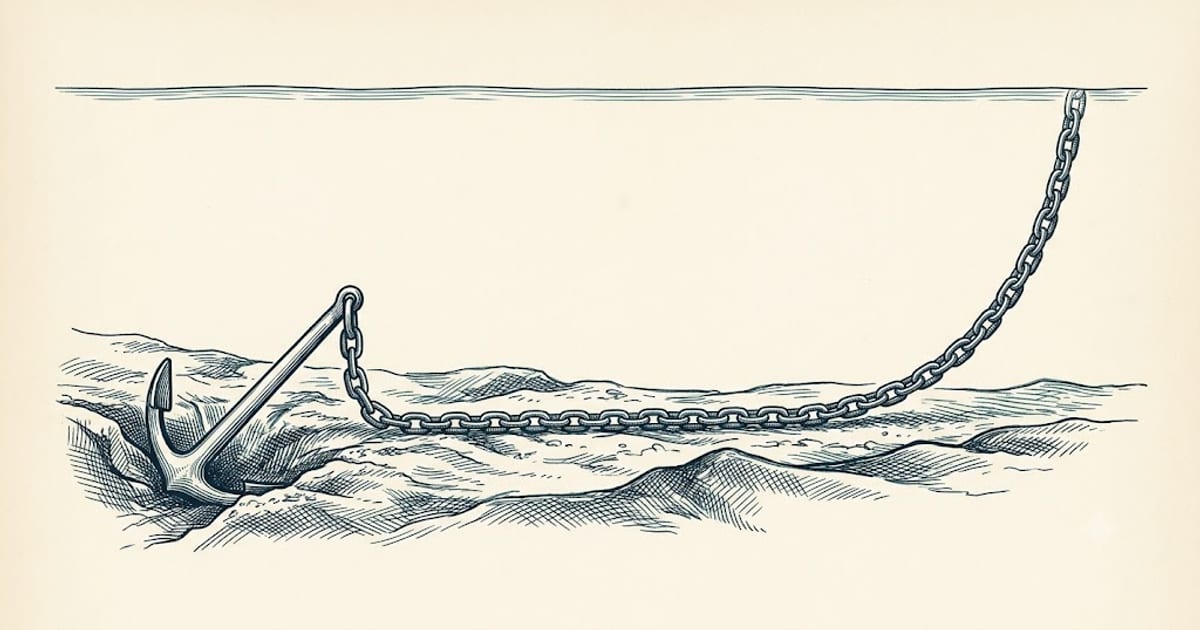
Every anchor sizing chart is a table of boat lengths. That is a reasonable index, because length is the one number every owner knows without looking it up. It is also the reason so many boats are under-anchored: the load that ground tackle has to resist does not scale with length.
The load rises with the square, not the length
The force trying to drag your anchor out of the bottom is, overwhelmingly, wind on the boat. Wind load is proportional to the area presented to it, and area scales with the square of linear dimension. A boat ten percent longer is also roughly ten percent taller and ten percent beamier, so it presents about twenty-one percent more area.
Run that out across the range:
| Boat length | Windage relative to a 30-footer |
|---|---|
| 20 ft | 0.44× |
| 25 ft | 0.69× |
| 30 ft | 1.00× |
| 35 ft | 1.36× |
| 40 ft | 1.78× |
| 50 ft | 2.78× |
A 40-foot boat is a third longer than a 30-foot boat and asks nearly twice as much of its anchor. This is why manufacturer charts step up in weight much faster than they step up in length, and why "it held fine on my old boat" is a bad argument for carrying the same anchor onto a bigger one.
Wind force also rises with the square of wind speed. Thirty knots is not twice twenty knots — it is a bit over twice the force. The two squares compound, which is the real reason anchoring goes from uneventful to frightening so abruptly.
Why this page will not print you a weight
Anchor weight is not comparable across types. A modern scoop anchor, a plough, a fluke-style lightweight and a claw of the same weight have very different holding capability in the same bottom, and the differences run in different directions depending on whether that bottom is sand, mud, grass or shell.
That means the only sizing number worth using is the one published by the maker of the anchor you are buying, read against the boat you actually own. Rocna, Mantus and the other manufacturers all publish selection charts, and chandlers such as West Marine reproduce them.
What is worth knowing is what those charts assume, because that is in the small print and it is where people get caught:
- Good holding ground. Charts assume the anchor can set properly. Weed, hard packed sand, rock and soft silt are all worse than the assumption.
- A working wind limit. Most charts are built around holding in something like 30 knots, some 50. Two charts can disagree by a whole size purely because they assume different conditions.
- Adequate scope. The chart assumes you deploy enough rode. Everything below is about that.
- One anchor, one boat. Charts size for a boat at rest in a normal anchorage. They do not size for a lee shore, for lying to an anchor in a swell, or for leaving the boat unattended overnight in unsettled weather. Those all argue for going up a size, which is why so many experienced cruisers do.
Sizing up is cheap; dragging is not. The cost difference between one size and the next is small compared with everything downstream of an anchor that lets go at three in the morning.
Scope: the part you control every single time
You buy an anchor once. You choose scope every time you anchor, and it changes the holding more than a size step in the anchor does.
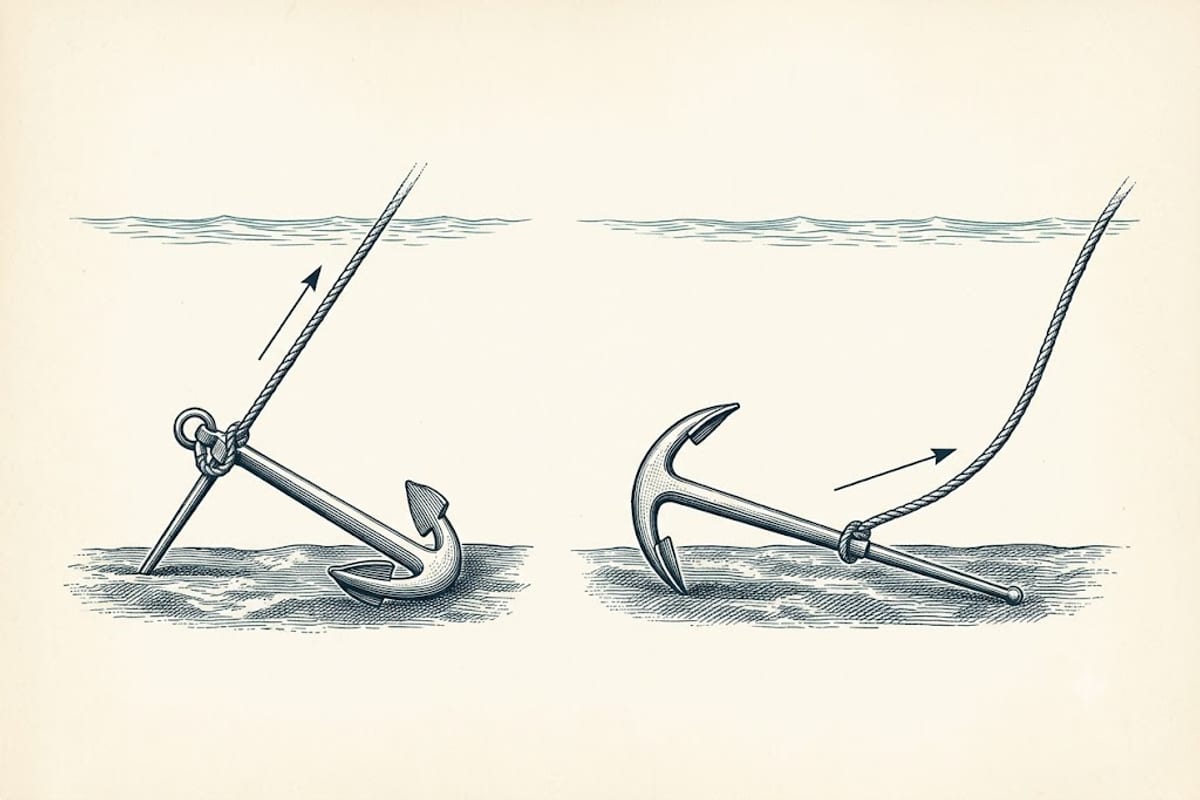
Scope is the ratio of rode deployed to the vertical distance from the bow roller down to the seabed. Its whole function is to make the pull on the anchor horizontal. An anchor is designed to be dragged along the bottom so it digs in; lift the shank and it comes out. Long scope keeps the pull flat, and the weight of chain lying on the bottom keeps it flatter still.
The measurement almost everyone gets wrong
Scope is not the ratio to water depth. It is the ratio to the total vertical distance the rode spans, which is three things stacked:
water depth + height of the bow roller above the water + the tide that will come in while you are there
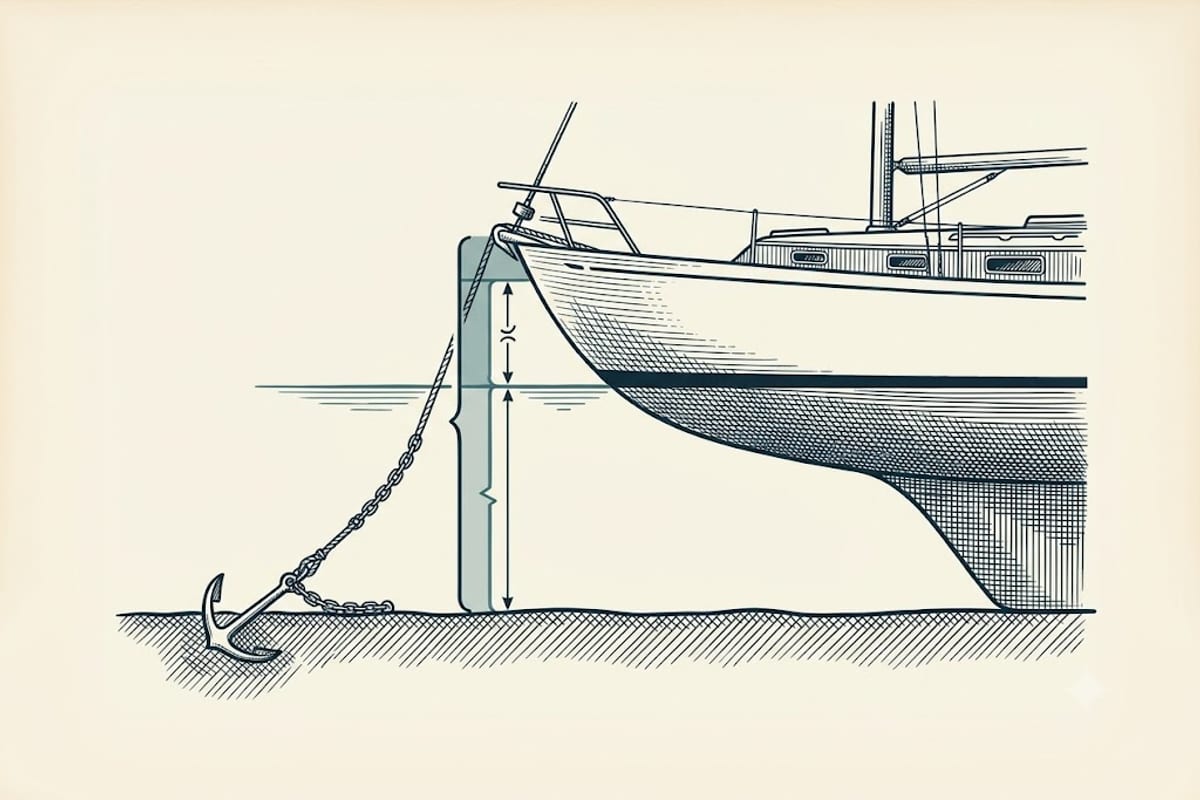
Miss the second and third and you have quietly cut your scope. In shallow water the error is enormous, because the fixed heights are a large fraction of a small total:
| Water depth | Under-deployed by |
|---|---|
| 10 ft | 41 % |
| 20 ft | 26 % |
| 30 ft | 19 % |
(assuming a 4 ft bow roller height and a 3 ft tide rise)
Someone anchoring in 10 feet who pays out "7:1" against the depth alone is actually at about 4:1 — and finds out at high water, in the dark, when the tide has added another three feet.
The rode table
Total vertical distance, and the rode to deploy at three common ratios. Bow roller 4 ft above the water, 3 ft of tide rise:
| Water depth | Total vertical | 5:1 | 7:1 | 10:1 |
|---|---|---|---|---|
| 5 ft | 12 ft | 60 ft | 84 ft | 120 ft |
| 10 ft | 17 ft | 85 ft | 119 ft | 170 ft |
| 15 ft | 22 ft | 110 ft | 154 ft | 220 ft |
| 20 ft | 27 ft | 135 ft | 189 ft | 270 ft |
| 25 ft | 32 ft | 160 ft | 224 ft | 320 ft |
| 30 ft | 37 ft | 185 ft | 259 ft | 370 ft |
| 40 ft | 47 ft | 235 ft | 329 ft | 470 ft |
Substitute your own bow height and the tide range for the day; those two numbers are boat-specific and place-specific and neither is optional.
Which ratio to use:
- 5:1 — all-chain rode, settled conditions, short daylight stop, and you are aboard watching.
- 7:1 — the working default. Rope-and-chain rode, overnight, ordinary conditions.
- 10:1 or more — heavy weather, a rode that is mostly rope, or anything you would rather not have to think about again until morning.
All-chain buys you scope. Chain lying on the bottom holds the pull horizontal by its own weight, which is why chain rodes are commonly used at lower ratios than rope. That advantage disappears in strong wind, when the chain lifts clear of the bottom and straightens — the moment you most wanted it. Do not treat the chain allowance as available in the conditions that made you want it.
Swinging room, which the scope table does not give you
Rode length is not swinging radius, but it sets it. A boat at 119 feet of rode in 10 feet of water swings on a circle of nearly that radius, plus its own length. That is a circle roughly 280 feet across, and every other boat in the anchorage is doing the same on their own ratios and their own rodes.
Before you decide on scope, look at what happens when the wind clocks 180 degrees at three in the morning and everyone swings together. That is the constraint that most often decides how much you can actually pay out, and it is a much better reason to shorten scope than "it seems like enough."
What this page does not cover
- It is not a substitute for the manufacturer's chart. Sizing an anchor is a safety decision; use the chart for the anchor you are buying and go up if in doubt.
- Bottom type changes everything, and no single anchor is best in all of them. Many cruisers carry a second anchor of a different type for exactly that reason.
- Chain and rope sizing, windlass matching and snubber design are separate calculations driven by breaking loads and gypsy compatibility.
- Setting technique matters as much as sizing — an anchor that has not been backed down on and proven is a decoration.
The chart tells you what to buy once. Scope is what you get right, or wrong, every night you spend on the hook.
Read next
- "Anchor Weight per Foot: The Rule of Thumb, and Where It Breaks" — A pound per foot is a rule that works in the middle of its range and fails at both ends, for two different reasons — windage at the top, holding ground at the bottom.
- Fluke Anchors: Where They Excel, and the Two Bottoms That Defeat Them — The fluke anchor has the best holding-to-weight ratio in common use and two well-known failure modes.
- Reading a Modern Scoop Anchor Chart, and What Its Small Print Assumes — Modern anchor charts look interchangeable and are not.
- Anchoring a 24-Foot Boat: The Questions the Chart Cannot See — Two 24-foot boats can need different anchors.