"Twenty-four feet" tells you almost nothing about what the boat asks of its anchor. It is the index every chart uses because it is the number every owner knows, and it is the weakest predictor in the whole calculation.
The reasoning behind that, including why load scales with the square of length, is in the anchor sizing page.
What actually sets the load
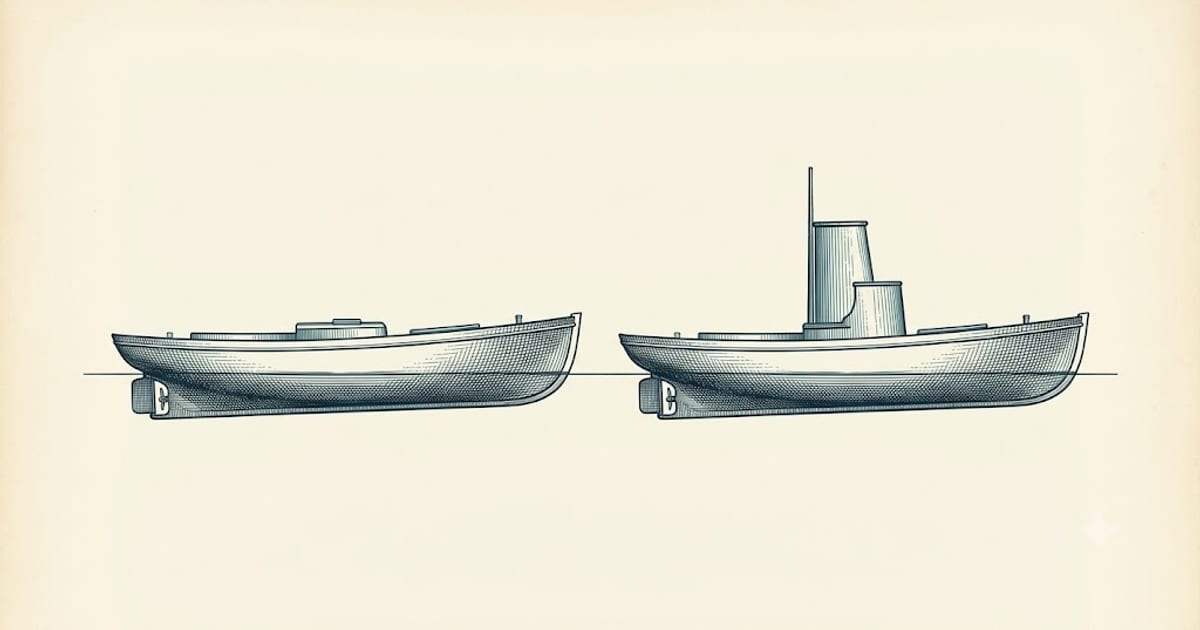
Windage, not length. The force trying to drag the anchor out is wind on whatever the boat presents to it. Two 24-footers can differ enormously:
- A low open centre console with a small console and no canvas.
- A cuddy cabin with a tall windshield, a bimini up, and a radar arch.
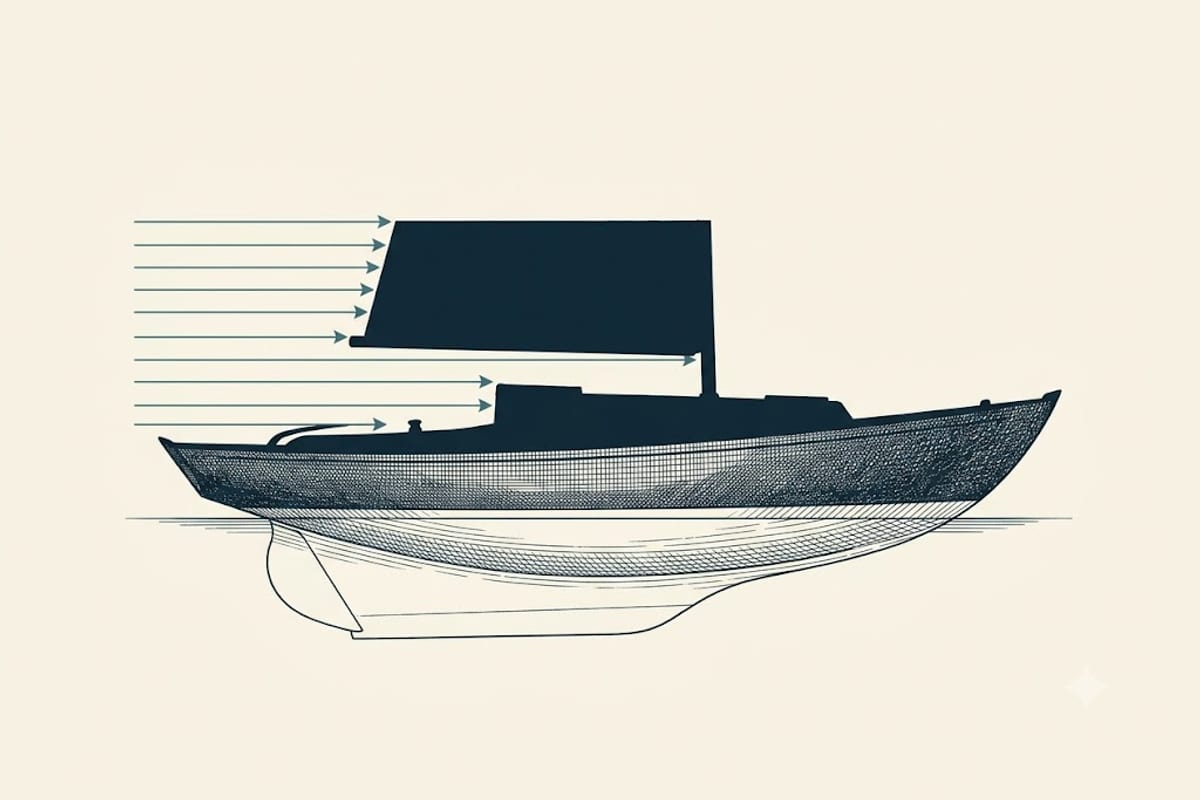
The second has a great deal more standing above the water, and in 25 knots it pulls considerably harder. The chart cannot see that, because both are 24 feet.
Displacement matters too, and in the same direction as intuition — a heavier boat carries more momentum when it snubs up against the rode in a chop, which is a shock load rather than a steady pull.
How to use a manufacturer chart properly
Every anchor maker publishes a selection chart. Rocna and Mantus both do, and chandlers such as West Marine reproduce them. Those charts are the sizing authority — not this page, and not a rule of thumb.
What matters is reading the small print, because charts differ on their assumptions:
- The wind speed they assume. Some are built around holding at 30 knots, some at 50. Two charts can disagree by a whole size purely from that.
- Whether they index on length, displacement, or both. The ones that use displacement as well are more useful.
- The bottom they assume. All of them assume good holding ground.
- Whether they are sizing a working anchor or a storm anchor. Different jobs, different answers.
Where the chart gives a range, or where your boat is near a boundary, take the larger size. The cost step between one size and the next is small. The cost of dragging is not.
The questions that decide it for a 24-footer
Rather than a number, four questions that move the answer:
1. Where do you anchor? A sand bottom in a protected bay is the easy case. Mud, grass, shell or rock are all harder, and no single anchor is best in all of them.
2. How long do you stay? A lunch stop where you are aboard and watching is a different requirement from an overnight, which is different again from leaving the boat unattended.
3. What is the worst weather you will be out in? Not the average — the worst. Wind force rises with the square of speed, so the gust matters more than the forecast mean.
4. Do you have a second anchor? Many owners of boats this size carry two of different types precisely because bottom conditions vary. That is often a better answer than one larger anchor.
Rode is the other half, and it is cheaper
An anchor that is one size up but deployed at 4:1 scope will hold worse than the smaller one at 7:1. Scope keeps the pull horizontal, and horizontal pull is what makes an anchor dig rather than lift.
For a 24-foot boat, the practical implications:
- Carry enough rode. In 20 feet of water with a low bow, 7:1 is roughly 170 feet. Anchoring in 30 feet needs well over 200.
- Some chain, always. A length of chain between the anchor and the rope does two jobs: it keeps the pull at the anchor horizontal, and it survives being dragged over the bottom in a way rope does not. A common arrangement on a boat this size is a boat-length of chain, though the right answer depends on your rode and windlass if you have one.
- A snubber if you are on all chain, to absorb shock loads that would otherwise go straight into the deck fitting.
Measure scope from the bow roller, and include the tide. In shallow water, forgetting those two understates your scope enormously — the numbers are on the main anchor page.
Setting matters more than size
An anchor that has not been set is a decoration. The sequence:
- Motor to the spot, note the depth, and work out your rode before you drop anything.
- Lower — do not throw — with the boat moving slowly astern.
- Pay out rode as the boat falls back, so the chain lies along the bottom rather than piling on the anchor.
- Snub off at scope, then back down with increasing power and watch a fixed point ashore.
- If it moves, retrieve and start again somewhere else. The bottom you chose is telling you something.
What this page does not cover
- Specific anchor weights. Use the manufacturer's chart for the anchor you are buying. This is a safety decision and a general-interest page is not the place for a number.
- Anchor types and bottoms — different designs suit different seabeds, and that comparison deserves its own treatment.
- Chain and rope sizing follow from breaking loads and windlass compatibility.
- Local regulations on anchoring, anchorages and required ground tackle vary.
Length gets you to the right page of the chart. Everything that decides the size is somewhere else.