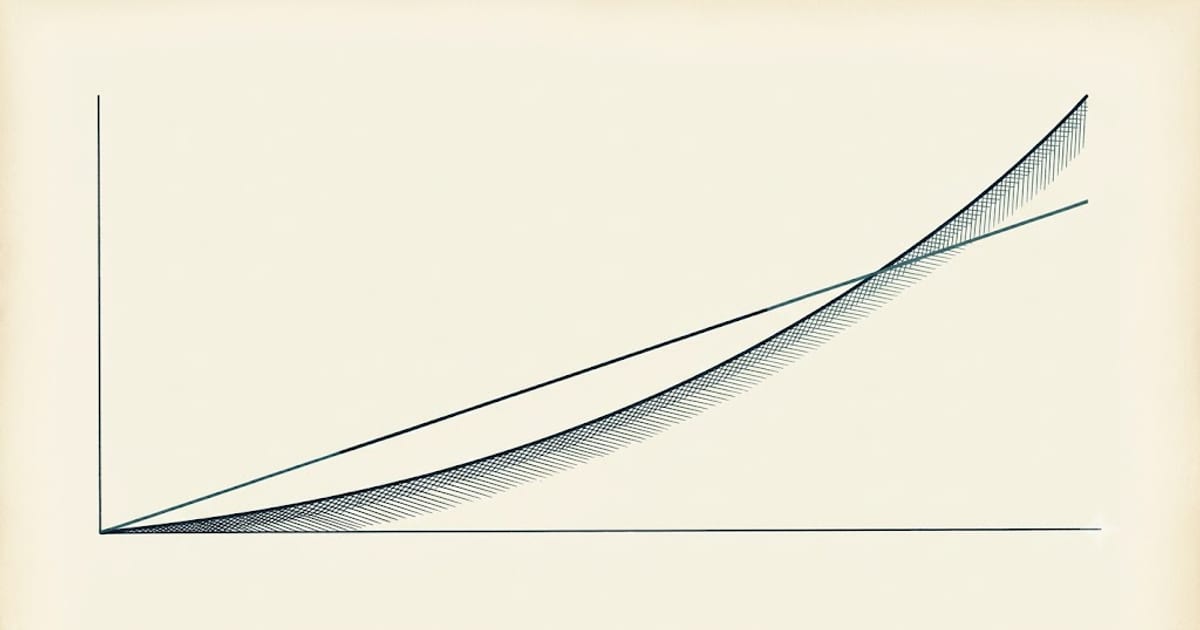
"One pound of anchor per foot of boat" is the oldest rule in the book. Like most rules of thumb it works in the middle of its range and fails at both ends, and it is worth knowing which end you are on.
The reasoning is in the anchor sizing page.
Why it fails at the top
The load an anchor resists is wind on the boat's exposed profile. That area scales with the square of the boat's linear dimension, because a longer boat is also taller and beamier.
| Boat length | Windage relative to 30 ft | Per-foot rule says |
|---|---|---|
| 20 ft | 0.44× | 0.67× |
| 25 ft | 0.69× | 0.83× |
| 30 ft | 1.00× | 1.00× |
| 40 ft | 1.78× | 1.33× |
| 50 ft | 2.78× | 1.67× |
A linear rule cannot track a squared relationship. By 50 feet, the per-foot rule is asking for 1.67 times the 30-foot anchor while the load has gone up 2.78 times — it is under by a wide margin, and the gap grows.
This is why manufacturer charts step up in weight much faster than they step up in length, and why "it held fine on my old boat" is a bad argument for carrying the same anchor onto a bigger one.
Why it fails at the bottom
At the small end the rule over-specifies, but that is not the real problem. The real problem is that on a small boat, weight is doing a different job.
On a large vessel with an all-chain rode, the sheer mass of the ground tackle contributes real holding through catenary — the chain lying on the bottom keeps the pull horizontal. On a 16-foot skiff with a short rope rode and a light chain leader, there is not enough mass for that effect to exist, so essentially all the holding comes from the anchor's ability to bury itself.
Which means: on small boats, design matters more than weight, and a well-designed light anchor can out-hold a heavier badly-designed one by a large margin.
What modern designs changed
The per-foot rule dates from an era of fisherman and older plough anchors, where holding correlated reasonably well with mass.
Modern scoop anchors changed that relationship. Their holding comes from fluke area and from a geometry that drives the anchor deeper as load increases, rather than from weight pressing it down. The result is that a modern anchor can hold considerably more than an older design of the same weight — and that any rule expressed purely in pounds is comparing things that are no longer comparable.
So weight is not a specification. It is a rough proxy that was reasonable when all anchors worked the same way and is now mostly a handling consideration: how heavy a thing you are willing to lift over the bow roller.
What to use instead
The manufacturer's chart for the anchor you are buying, read against your boat and honest about your conditions. That is the whole answer. Rocna, Mantus, Lewmar and the rest all publish them.
Three modifiers worth applying to whatever the chart says:
- Go up a size if you leave the boat unattended, anchor overnight regularly, or cruise where the weather changes fast.
- Go up a size for poor holding ground — grass, soft silt, hard-packed sand.
- Do not go down a size to save weight. If the size the chart gives is more than you can handle on the bow, that is an argument for a windlass or a different anchor design, not for a smaller anchor.
Where weight still matters
Two places, both practical rather than theoretical:
Getting it to set. A very light anchor can skate across a hard bottom instead of biting, particularly if it lands badly. Some weight helps it find its orientation and start digging.
Handling. An anchor you cannot lift is an anchor you will not deploy, and one you will be tempted to leave down too long in deteriorating conditions. That is a genuine safety consideration and it is the reason the size step is a real decision rather than "always buy the biggest."
What this page does not cover
- Actual weights. Use the chart for the anchor you are buying. This page explains why per-foot rules mislead, not what to buy.
- Anchor types and how each behaves in different bottoms.
- Scope — which changes holding more than a size step does. See the main anchor page.
- Chain and rode weight, which contribute to holding on larger boats and barely at all on small ones.
A pound per foot is a straight line drawn under a curve. It touches in the middle and is wrong at both ends.