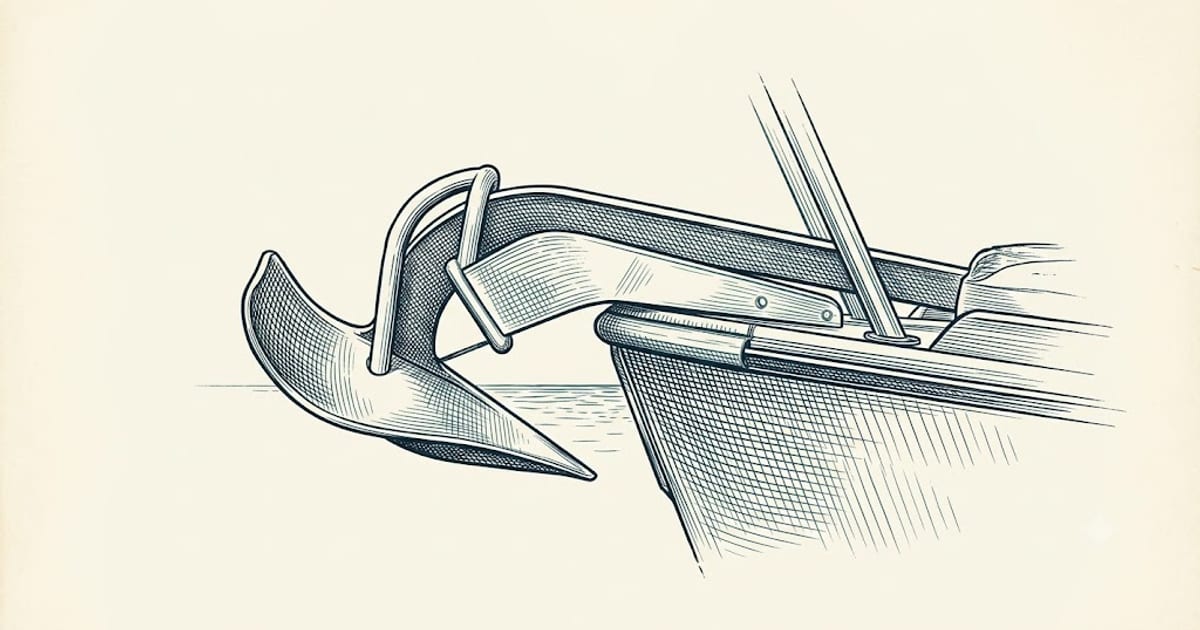
Anchor design changed meaningfully around the turn of the century, and the change is geometric rather than commercial.
Traditional designs — the CQR and other plows, the Bruce-type claw, the Danforth-type fluke — have convex or flat surfaces. Under load a plow tends to skid and dig at the same time, and how much it digs depends heavily on the bottom.
New-generation designs — Rocna, Manson Supreme, Spade, Mantus, Ultra and others — use a concave fluke with a weighted or ballasted toe, usually with a roll bar or a shape that self-rights.
A concave surface pushes bottom material toward the centre as it is dragged, which drives the anchor downward. The harder you pull, the deeper it goes. That is the whole idea.
Where the gap shows
Setting distance. New-generation anchors typically bury within a boat length or two. A CQR can drag considerably further before it takes, and on a short scope it may not take at all.
Re-setting after a wind shift. This is the largest practical difference. When wind or tide swings a boat 180°, the anchor is pulled out backwards and must re-bury. Concave designs generally do; hinged plows frequently trip and skid instead.
Since the 2 a.m. wind shift is the scenario that actually loses boats, this matters more than peak holding figures.
Holding per pound. Independent comparative tests have consistently placed new-generation designs ahead for their weight, though absolute numbers vary so much between bottoms that the ranking matters more than the figures.
Where traditional designs still earn a place
Fluke anchors in firm sand remain outstanding — more holding per pound of stowed weight than anything, and they stow flat, which is why they persist as secondary and stern anchors. Their weaknesses are covered in fluke anchors.
Claw anchors in rock and rubble. They hook where nothing buries, and they are forgiving of poor setting technique.
A second anchor of a different type is more useful than a second of the same. If your primary is a modern scoop, a fluke or claw as backup covers the bottoms the scoop is worst at — see anchor types by bottom.
Do not size down
New-generation anchors hold better for their weight, and the tempting conclusion is to buy smaller.
Manufacturers' size charts already account for the improved design. A Rocna sized from a Rocna chart is not equivalent to a CQR of the same weight; it is equivalent to a much heavier CQR. Sizing down from the chart on top of that removes the margin the chart was built with.
Weight also still matters on its own — it is what gets the toe into the bottom in the first place, particularly through weed. Chart sizing is in anchor sizing for boats.
Bow roller fit
Roll-bar anchors are bulkier than plows and do not fit every bow roller. Check the fit — including whether the roll bar clears the forestay and whether the shank sits properly — before buying.
This is the most common practical obstacle to upgrading, and it is easier to establish with a tape measure than after delivery.
FAQ
Are new-generation anchors really better?
For setting speed and for re-setting after a wind shift, consistently yes. The concave fluke drives the anchor deeper under load where a plow tends to skid.
Is a CQR a bad anchor?
Not bad, but slower to set and less reliable at re-setting than modern designs. Many have held boats for decades.
Can I buy a smaller new-generation anchor?
No. Manufacturers' charts already reflect the improved design, and weight is still what drives the toe into the bottom.
What is the roll bar for?
It rights the anchor so the fluke lands in the digging orientation regardless of how it hits the bottom.
Should I keep my old anchor?
Yes, as a second of a different type. A fluke or claw covers bottoms a scoop handles poorly.