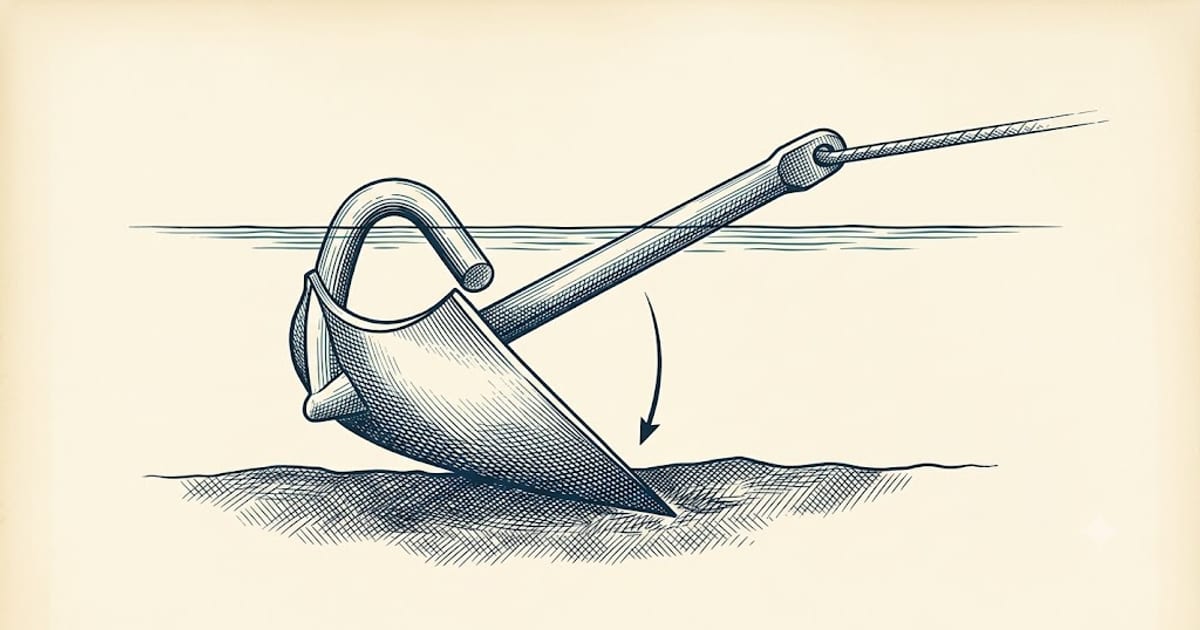
Modern scoop anchors — the concave-bladed designs with a roll bar or a weighted toe — changed the relationship between anchor weight and holding power. Their charts look similar to older ones and mean something different.
The sizing principles are in the anchor sizing page.
What the design does differently
Three features, each addressing a specific failure of older anchors:
A concave blade. As load increases, the shape drives the anchor deeper rather than planing it out. Older ploughs tended to reach a holding plateau; a scoop keeps digging.
A roll bar or weighted toe. Ensures the anchor lands and stays in the correct attitude to set. Older designs could land on their back and stay there.
A high fluke-area-to-weight ratio. More blade in the ground for a given lump of steel.
The result is an anchor that sets faster, sets more reliably from a bad landing, and holds considerably more per pound than the designs the old rules of thumb were written for. It is also why weight is a poor way to compare anchors across types — see anchor weight per foot.
Why two charts disagree
Put two manufacturers' charts side by side for the same boat and you will often find they recommend different weights. That is not one of them being wrong. It is usually a difference in the assumed conditions, stated in small print:
- Assumed wind speed. Some charts size for holding in 30 knots, some for 50. Wind force rises with the square of speed, so 50 knots is nearly three times the load of 30 — enough to move the recommendation a full size.
- Assumed use. Working anchor versus storm anchor.
- Whether displacement is an input. Charts that use length alone are cruder than those that also ask for displacement, and a heavy displacement boat at a given length needs more than a light one.
- Whether the boat is assumed to be attended.
Read the assumptions before comparing the numbers. Two charts that agree on assumptions rarely disagree much on size.
The size-up argument
Almost everyone who anchors regularly ends up carrying more anchor than the chart's minimum. The reasoning:
- The cost step between adjacent sizes is small relative to the boat.
- The consequences of dragging are not symmetric — nothing good happens from having too much anchor, and a great deal that is bad happens from having too little at the wrong moment.
- Charts assume good holding ground and you will not always get it.
- The weather you actually meet is worse than the weather you planned for, some of the time.
The counterweight is handling: an anchor you cannot get over the bow roller is one you will hesitate to deploy. If the size the chart gives is beyond what you can manage by hand, that argues for a windlass rather than for a smaller anchor.
Bow roller fit
A practical constraint that catches people after purchase. Scoop anchors with roll bars have a specific geometry, and not every bow roller will accept every anchor cleanly. Before buying:
- Check the anchor stows and deploys without fouling the bow, the forestay or the furler drum.
- Check it self-launches if that is how you intend to use it.
- Check the roll bar clears whatever is above the roller.
Manufacturers publish dimensioned drawings for exactly this reason. Rocna and Mantus both do.
What the chart still cannot tell you
The bottom. Every chart assumes good holding ground. Modern scoops are markedly better than older designs in weed and soft mud, which is one of their main advantages, but "better" is not "immune."
Setting technique. A scoop anchor sets fast and reliably when deployed properly — lowered rather than thrown, with the boat moving slowly astern, rode paid out as the boat falls back, then backed down hard to prove it. Dropped in a heap on top of itself, it can foul on its own chain like anything else.
Scope. Nothing in the design removes the need for scope. The concave blade digs deeper under horizontal load; under a steep pull it comes out like any other anchor.
What this page does not cover
- Specific weights. Use the manufacturer's own current chart for the anchor you are buying.
- Type-to-type holding comparisons, which depend heavily on bottom and on whose test you read.
- Rode, chain and windlass matching, driven by breaking loads and gypsy compatibility.
- Genuine copies versus lookalikes — the geometry is what makes these anchors work, and approximations of it do not necessarily perform the same.
Better anchors than the rules of thumb were written for. The charts are still only as good as the small print you did not read.