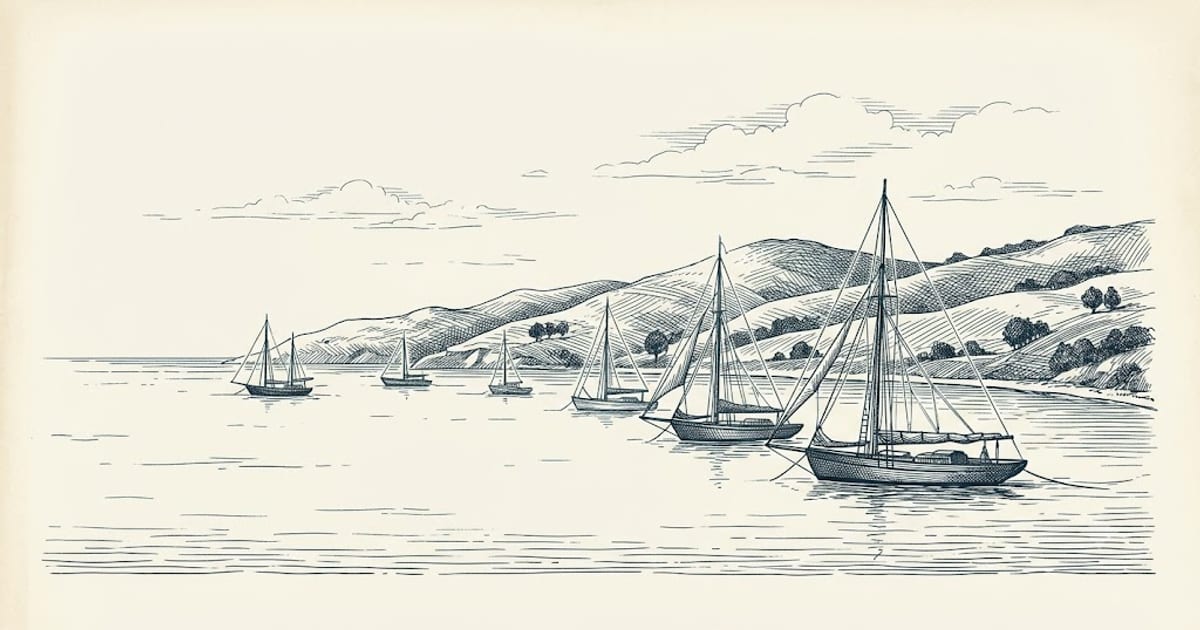
Your boat can be anywhere on a circle whose radius is rode paid out plus boat length.
At 100 ft of rode on a 30 ft boat, that circle is 260 ft across. Anchoring 60 ft from a neighbour is anchoring inside their circle.
The arithmetic is easy. What causes contact is that different boats have different circles.
Boats do not swing alike
Different scope. A boat at 7:1 has a much larger circle than one at 4:1 in the same depth. They lie together comfortably in steady wind and sweep across each other when it shifts.
Chain against rope. All-chain rode sags and its effective radius changes with load; nylon stretches. In a gust one boat surges back and the other does not, at different rates.
Windage against keel. A high-sided motorboat responds to wind; a deep-keeled sailboat responds more to current. When wind and current oppose — common at a tide change — they lie in different directions, sometimes 90° apart or more.
That last one produces the classic 2 a.m. surprise: everything was fine until the tide turned.
Where to drop
Watch before you commit. Spend a few minutes looking at how the boats already there are lying and how far apart they are. They have already solved the problem for the current conditions.
Anchor astern of similar boats, not among dissimilar ones. A sailboat among sailboats will behave predictably.
Drop ahead of where you intend to sit, and drift back onto your scope. Your anchor ends up roughly a scope-length forward of your final position, so account for that when judging the gap to the boat ahead.
Leave more room than looks necessary. The gap you judge in daylight is the gap at that moment, in that wind direction.
Who is expected to move
Convention: the boat that anchored last moves. Boats already established have the position.
It is a convention rather than a rule, and it does not decide a collision at night. If your neighbour is dragging or lying badly and you cannot raise them, move regardless of who arrived first — being correct is worth nothing at three in the morning.
Speak to neighbours when you arrive if there is any doubt. Most people would rather answer a hail than be woken by fenders.
Practical habits
- Note your position and depth when set, so you can tell later whether you moved.
- Take a transit ashore and check it before turning in — the method is in how to set an anchor.
- Set an anchor alarm, accepting it will occasionally cry wolf.
- Have fenders accessible, not in a locker under the berth.
- Check the forecast for wind shifts, not just strength. A shift in a crowded anchorage rearranges everyone at once.
If it does go wrong, the sequence is in what to do if your anchor drags.
FAQ
How much room do I need between boats?
Your swinging circle is rode plus boat length as a radius. Two boats need their circles not to overlap, which is more distance than most people assume.
Why do boats swing differently at anchor?
Different scope, different rode material, and different balance between windage and keel. Wind against current makes it worse.
Who has to move if boats swing together?
By convention the boat that anchored last. It is not a rule, and safety outranks it.
Where should I drop the anchor relative to other boats?
Astern of similar boats, dropping ahead of where you intend to lie so you drift back onto your scope.
Should I use an anchor alarm in a crowded anchorage?
Yes, alongside a transit ashore. Expect occasional false alarms from normal swinging.